 German
 Vietnamese
14 – FOR HUSBANDS – CTW-2022-E
14 – FOR HUSBANDS – CTW-2022-E
CHALLENGED TO WIN by Gregory Fernandez
Chapter 14 – FOR HUSBANDS
The introduction had this text.
I am repeating the text here because it orients us.
The Chapters ‘FOR HUSBANDS’ and ‘FOR WIVES’ are necessary because men and women have unique thinking approaches when their emotions are involved. For example, it is not uncommon for men to think that everyone thinks like a man or for women to believe that everyone should think like a woman. The understanding is that men and women will likely feel differently if the HEART is involved.
If the topic or question only involves the HEAD, both men and women will be aligned. For example, if the problem was a mathematical problem. It is a HEAD problem – the thinking will be uniform. If there is a difference, it will be more of a PREFERENCE difference. For example, girls, in general, may prefer something other than mathematics.
If we fail to recognize there are THINKING DIFFERENCES BASED ON THE SEX, we will end up blaming people just because they don’t think like us.
—-
Most men find books on marriage uninteresting and skittish. This topic does not fit into masculine thinking. Quite frankly, I, too, belonged to that group. Only after I had problems, I decided to get to the causes. I took up this activity like a student. I was determined to win my marriage, so I did what I could to acquire the knowledge. This chapter is by a man for men. Sometimes I wonder if certain men might want to start the book at this chapter and then move back to the beginning of the book. Maybe this chapter is a better starting point for some men. This chapter can stand alone without needing to read the other chapters first.
It is a fact that men know very little about women. Some people may like to contest this point. Men may be inclined to say it is invalid, and their spouses may say it is true, especially a wife about her husband. However, other women are saying the same thing about their husbands.
It is a fact; that men know remarkably little about how women think. It is astonishing because men have a relatively broad pallet of interests. On average, even from childhood, girls take to reading far more quickly than boys. Boys do not seem to have time for reading. Somewhere at a later age, when they see the purpose, they read and mix the perusal with analyzing. Their most vital motivation to read is when they can see a goal. Then, with much interest and care, they read, discuss, and even take the trouble to learn about various things. On the other hand, they shun reading if they do not see the purpose. It is like asking a boy if he finds any pleasure in learning a second language at school.
Many boys and men have an unspeakable drive to conquer a more comprehensive knowledge selection. It is the ‘Hunter’ in him. In man’s primitive role, man has been the ‘HUNTER’; he went out to get things. Maybe hunt for food. Instinctively his knowledge search is very goal oriented. Today a man may not go out to hunt wild boar and buffalo, but he still goes out to hunt for the Mighty Dollar.
Some go to factories, offices, and other places of work. In women’s primitive role, the woman has been the ‘GATHERER’. She gathered and maintained what she had. She looks after the home, children, aged parents, livestock and many tasks.
This era and society have shown acceptance of an overlap of the roles of men and women, but there are still some residual and instinctive preferences.
Let us sidestep for a minute and see what has influenced this homogenization of the roles. One major factor in recent times has been the two World Wars. Almost all the men of certain warring nations had to fight. So, most men’s jobs had to be taken up by women. After the war, the family had to rebuild assets, so people expected women to help. There was a healthy acceptance of allowing women to study. When women learned, they had the potential to contribute to domestic and national productivity. These and many factors have contributed to changes.
The HUNTER – GATHERER Challenges
On one side, Wars, especially the Second World War, turned the women’s role of a GATHERER into a HUNTER by forcing her to become the BREAD-WINNER.
It also gave the wife and many other family members the benefits of TWO-HOUSE-HOLD INCOMES. It isn’t easy to revert to a ONE-HOUSE-HOLD INCOME.
MODERN SOCIETY twists the orientation in the direction of FINANCIAL INDEPENDENCE and PERSONAL ACCOMPLISHMENT. These factors also challenge the women’s FREE WILL.
The price is the God-given role of Wife, Motherhood and Family. There are many Pro and Contra arguments. It is not the purpose of this book to open this topic but to leave each person to discuss their thinking in prayer with God.
Back to the topic:
Men seem interested in seemingly insignificant things, like some tiny chip in a computer. How they devour information about planes, rockets, football, cameras, and computers makes anyone wonder how they can handle various interests. Sometimes, the way they show interest in planets and comets makes you almost wonder whether they plan an excursion there. In many ways, these interests have paid off. They have invented, thought up, developed, discovered things, and even travelled through the skies. But, while their search for knowledge in many fields is far stretching, their reading (and understanding) about marriage, family and women’s behaviour is surprisingly absent. When considering topics like “wife” and “motherhood”, we can almost safely grade their knowledge at zero. In gathering knowledge, these ‘exclusively woman topics’ lie outside their area of interest. As a result, they are inclined to sweep away such issues with an air of irrelevance.
By way of explanation:
It is not that men are not concerned. They are concerned, but the drive towards their concern is different. Men work with what is known as “THE ALL IS WELL DRIVE”. If the wife is there, the children are there, food is there, ‘All is well. They tend to have a global view that fits the “ALL IS WELL”. By way of example, if his child is in school, ‘all is well. He may not necessarily concern himself about the micro level of things, like whether the children’s clothes are ready or getting the homework done. Another example: If the household has a kitchen, he may think nothing of using the kitchen sink and countertop for his experiments. It does not occur to him that his wife is less enthusiastic about the invasion of ‘her’ domain. If she does not say anything, ‘All is Well’. If she does, she has breached his ‘All is Well’. In simple language, she has nagged him.
On the other hand, some have reached the COMMUNION STAGE (see chapter 5). They either supported the experiment or joined the investigation. Women, who could do that, have made many good things out of their men. One lady once answered the reporters who asked her what she thought about the new car factory her husband built and that so many cars would be rolling out every day from her husband’s factories. She said, “I am naturally happy about it. However, I am satisfied knowing my husband made my backyard’s first car. “There were times when the backyard grew large enough to include the kitchen, the dining table, the living room and other areas of the house”. An answer like that brings admiration to any man’s eyes. A wife’s answer like this reveals, “Understanding at the highest level”. A wife’s understanding is the epitome of a splendid wife. The impact is that today, there are hundreds of thousands of jobs that live for years and years. It has brought food to the table of countless people. Education centres, Research centres, Hospitals and many other things have materialized. The legacy continues even years after she and her husband have passed on. So many good things happened because a wife joyfully allowed an ‘Idea’ called a car to take shape. The first car built was in ‘her’ backyard, kitchen, and living room. At home, the husband called her Callie. He referred to her greatly to selected people as “The Believer”. Some knew her as Clara Bryant Ford. And the world at large knew her as Mrs Henry Ford.
This story did not come to me by my reading. I overhead, some informative wife, make the analogy of Mrs Henry Ford’s words to her friend. It gladdened my heart immensely and significantly impacted the machines we built. I know that the kitchens, living room, dining room, various furniture pieces, the roof and under the bed were all annexed into work areas. Invariably with untidiness. The person who made this analogy is known as Mrs Gregory Fernandez.
Back to the topic:
By contrast, girls, young women, and women generally read more about these marriage topics. Even their leisure choice of reading materials is in this direction. Consequently, they expect their husbands must at least have some idea and feeling of how a woman thinks. What they get instead is quite a surprise. The man is like a boy who was just born yesterday, or they hear remarks like, “I can never understand women”. “Are women creatures from another planet?” “Do women have any capability to think?”
The main reason is that men and women think differently, and there is no doubt about that. Different emotions trigger both. These differences came up in the previous chapter. In this chapter, we want to explore these differences deeper.
When I think of some of my experiences, they make me smile now, but it was many different things ranging from surprise to annoyance and exasperation -sometimes for me and sometimes for my wife. For example, mechanical things are a part of my work and connecting these things is almost my daily occupation. Moreover, I do a lot of work from home. For example, my wife asked me to attach a fresh gas bottle to the stove one day. I said I do not know how to do it. My wife could not understand this. She almost went through the roof with anger. She thought I was cheeky and that I just wanted to irritate her. The reality of it all is that I have never exchanged a gas cylinder for a stove. Nowhere in my training did I have to think of such a duty. To make matters even more unbelievable for her is that she is an expert in household mechanics. In due course, she realized my behaviour was neither a joke nor malice but just ignorance. Later, I found her narrating this incident to my mother with amazement.
With this small example, I want to illustrate how ignorant I was in household activity, and my wife was surprised. In a way, I was surprised that she could be surprised because from the age of 8 and a half until the day I got married, I lived in boarding schools or hostels, and everything was ready in the dining hall. After meals, we just walked away. When I came home from the boarding school or hostel, my mother never required me to do anything. She treated my homecoming as her only chance to flex her cooking muscles. I was intrigued that Rose could be surprised, so I examined this subject from different angles. One angle is the religious angle which is the primary orientation of this book. The whole story of how I could explore this subject from a spiritual angle is quite an experience; I have described that in other chapters- partly in the Prolog and partly in the Epilog. The other is the human angle relating to physiology, psychology or behaviour.
The religious angle helps us to put our attitudes into a proper perspective with God and to get a correct relationship with our spouse.
The human angle helps us understand our self, the other self and the inter-relationship between the two selves.
Let us also examine this topic from a medical, psychological and behavioural point of view.
A PRECESSION
A wife is also a mother at the same time. In this context, it would be correct to consider this aspect and say a few words about this role. The skill of being a wife and a mother is noteworthy. It is of the utmost importance for the health and vitality of our society. It is regrettable to mention the lack of respect and status that today’s society gives to ‘House Wives’. Even the word ‘House Wife’ is often synonymous with unfulfilled, inferior and meaningless. It is a pity. We are making a great mistake in devaluing the role of the housewife.
A husband and his work impose unique frustrations and tensions on the wife. We must face this fact squarely. Apart from looking after small children, which is very exhausting and irritating, it is a job for the full 365 days a year. In this process, her nerves are constantly juggled and jangled. No wonder she feels like running away from the arena and is often curious, “What am I doing here?”
Women also often encounter problems and pressures which are less familiar to men. The loneliness of adult company is widespread among wives who remain at home. Often she experiences a deep, persistent yearning for adult contact. She longs for the laughter and romantic love of her younger days. Many women who have experienced this need to try to reach out and communicate this to their husbands, hoping they will be able to supply the missing ingredient. She desperately wants him to understand her yearning and frustration, but it seems she cannot attract his attention. Instead of attracting empathy and support, he may interpret her efforts as nagging, grumbling, self-pity, or hostility. When this happens, most men tune out. Either they do not hear, or they go away or react negatively. This behaviour conveys, “What kind of a problem does ‘this’ woman have?”
It is certainly not the aim of this chapter to knock men on the head. There are already enough expressions to describe the husband and father with words. Some terms include idiot, bigot, exploiter, misogynist, football fanatic, sex maniac and self-centred egoist. The way some women say it sounds as though men are lower than muck. While men undoubtedly have feelings, it is best to put them aside. Just consider these tribulations as skill and patience training. But, of course, these accusations are doubtless exaggerated; after all, which women would have gone headlong into marrying such a character in the first place?
On the other hand, too many men do not understand the emotional needs of their wives. They live in vastly different worlds with many frustrations of their own! The husband is incapable of putting himself into their wife’s thinking grid or seeing and feeling the way she does, or they are too preoccupied with their work or does not listen. Regardless, women still have needs that men do not easily comprehend. The aim and purpose of this chapter are to illuminate this to men and provide some insight. In a way, this was also the motivation behind writing these pages. Because I had so little knowledge and consequently made so many mistakes, I would like to dedicate this chapter in a particular extra way to my wife, Rosemarie.
This chapter is not for men’s eyes; it is designed equally for the lady to read. However, in a way, we must face specific facts squarely, and one of them is that more wives read such books than husbands. So this chapter may help the wife to communicate her needs and feeling to her husband.
B The Objectives
Some of the objectives of this chapter are:
1) Help women explain their unique needs to their husbands.
2) Understanding emotional isolation.
3) Encouraging more fulfilling motherhood.
4) Understanding depression and its solution.
5) Understanding everyday irritations.
6) Motivating self-esteem.
7) Understanding how to revive romantic love.
All this sounds ambitious; however, it is easier to shoot straight if we know where the target is. So let us begin with a discussion of the source of depression in women.
Anyone can experience DEPRESSION in the following ways:
Despair, discouragement, disinterest, distrust, hopelessness and disenchantment.
Both women, as well as men, are susceptible to depression, but there are noticeable differences between them:
Depression in women is a lot more frequent than in men.
In men, depression is crisis-oriented. It happens because of business setbacks, illness, or changes in life activities, i.e. Retirement. In women, the causes of depression are vague, generalized, and almost unidentifiable.
If we understand the patterns of emotions, we can minimize the impact of depression. Every person has a cyclic emotional way. It consists of HIGHS followed by LOWS; the influence flow would look as follows:
Unfortunately, the diagrams will not appear in the audio version.
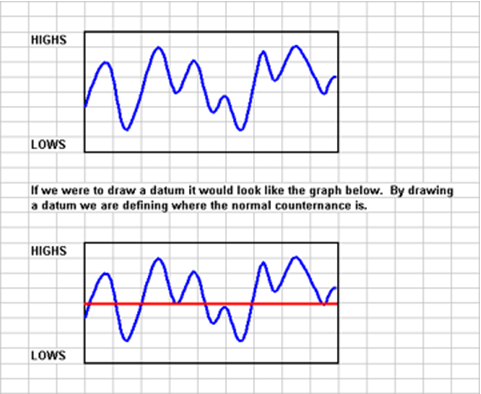
The area of HIGH and LOW would be almost equal in amplitude and frequency.
The amplitude, as well as the frequency, differs from person to person.
Unfortunately, the diagrams will not appear in the audio version.
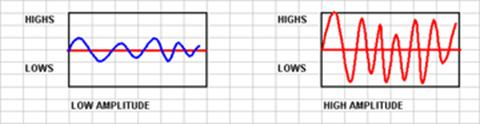
A person of low amplitude would take the good and bad news with about the same calm. They would not be too excited about anything. They will be rather dull people.
On the other hand, people with high amplitude would have marked expressions of joy but equally drawn terms of sorrow. They are like an emotional Yo-Yo.
The change frequency would differ within the same type, regardless of the amplitude.
Unfortunately, the diagrams will not appear in the audio version.
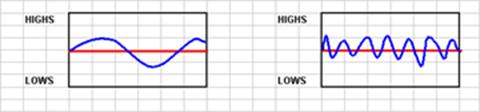
Low amplitude with Low amplitude with
Slow change pattern frequency change pattern
Likewise
Unfortunately, the diagrams will not appear in the audio version.
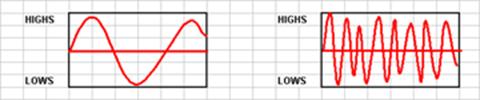
High amplitude with High amplitude with
Slow change pattern frequent change pattern
Within limits, the curve characteristics of human types are not ‘good or bad’ . They are just patterns of differences between one person and another. Because of character differences, we have varieties of human types. As I mentioned, all these curve patterns can be considered normal within reasonable limits. The point of care is how these human types interact. We will always prefer some curve pattern ideal for our spouse, perhaps another design for a colleague, and another way for another task. We expected to assess people and try to assign values to their activities. Even though the characteristic curves are insightful, it is silly to try and match people or choose mates only based on these curves.
For one thing, each person’s curve is different. It is like his emotional fingerprint; besides, there are complementary advantages if different patterns are available. There will be the advantage of looking at a situation from two or more angles with varying curve patterns. The trick is not matching the curves but understanding them. It is essential to understand one’s self and partner. The aim is to use both characteristics by learning to adjust and consider each other’s emotional ‘ups’ and ‘downs’. A part of our marriage’s success depends on the words ‘Adjustment and ‘Consideration’. THE OTHER PART DEPENDS ON BOTH PARTNERS UNITING THEIR WILL TO THE WILL OF GOD.
Marriage is not a bi-union but a tri-union GOD HUSBAND WIFE.
A person was once describing a situation while at a music concert. In front of him was a man who most certainly understood music well. During the show’s first half, he seemed ecstatic with each piece of music. First, he would hold his chest and sway. Then, he would jump up and applaud at the end of the work. It was almost entertainment by itself to watch him.
After the interval, however, when the kind of music changed, he seemed disgusted; everything seemed either false or full of mistakes; he fumed now and then. And finally, he jumped up and stalked out of the hall in the middle of the music. This man would be an example of a person with high amplitude.
I have chosen to write about the types of curves because we should know that we, all of us, have ‘highs’ followed by ‘lows’. If we know this, we can better manage the ‘highs’ and ‘lows’. We will also be able to judge when the change is likely to occur, and surprises will not catch us. We can learn to adjust to our emotional and our partner’s rhythms.
For example, a couple bought a house and were thrilled with their new acquisition; they went around each room planning and visualizing and fantasizing about what they would put in it, how to arrange it, etc. Both were living in a ‘High’. Fortunately, both knew about the emotional curve rhythm. One day the husband told the wife, Darling, we have been elated for a long time, and our moods are bound to dip; when that happens, we will ‘lie low’ and know that at some time, the ‘Lows’ will take an upward turn.
Right enough, the ’low’ took place unavoidably and cyclically. When the ‘low’ came, neither was surprised, and they expected it. They were both aware that ‘low’ would cyclically turn towards a ‘high’.
Since this is important, I will try to itemize the purpose of the curve.
1) To understand oneself.
2) To understand the partner.
3) To enable a basis to show consideration and adjustment.
4) To predict and cope with ‘Up’ and ‘Lows’.
5) To expect and look forward to ‘Highs’.
6) To avoid unnecessarily getting annoyed and blaming all other people when in most cases, the only reason is the emotional ‘low’.
Psychologists are not overly concerned about amplitude or frequency as long as they are within reasonable limits. They feel ‘Highs and Lows’ are only a matter of adjustment and consideration. What bothers psychologists is if the period of the emotional cycle is disturbed. For example, if it occupies an unduly long period of high or low like this.
Unfortunately, the diagrams will not appear in the audio version.

Prolonged Low Prolonged High
It is this unfluctuating state which is a matter of concern.
If the person retains a prolonged ‘high’, it is usually not bothersome to others; people may be taken up with his cheerfulness and probably ask questions like, “What is the secret of your happiness?” They will perhaps envy him. The real question is, have they learned to maintain a positive attitude towards all (or at least too many of life’s changing situations? If attitudes keep their mood high, we should learn from them.
What is usually bothersome is the prolonged ‘Low’, and if a person cannot pull themselves out of the ‘Low’, this makes them unhappy. Those who have to interact with this person will feel the strain. The prolonged ‘low’ progressions will be: low, depression, discouragement, loss of courage and will, despair, and suicide. Extended ‘lows’ may not necessarily slide down towards Suicide it may reach an equilibrium somewhere along the gradient. Whatever the reason for Prolonged ’Lows’, it can be self-destructing, and help may become necessary. Under support, I mean prayer, the sacraments, friendly confiding, counselling, encouragement, cultivation of knowledge of self and others, cultivation of an attitude, and Inner healing. Medicines and medical techniques like psychiatry and drug treatments are only under extreme conditions. As far as possible most people do not need these in the first place. They need only an attitudinal change to improve their outlook and insight. They need to orient themselves away from ‘The Selfish Ego’.
Medical techniques tend to interfere with their physical and mental makeup and hook people to drugs or treatments. Patients will have to cope with Withdrawal Symptoms as an additional nuisance. It also leaves a bad stigma on them. These Stigmas are very difficult to erase. Besides being very costly, they risk running the person permanently through the grounds. As far as possible, avoid clinical psychiatry because it has made and kept patients as ‘Ginny Pigs’ in the hand of evil career criminals. It has legality to experiment with the patient by its very nature. If anything goes wrong, the profession is not at fault. But, of course, we cannot turn to every professional and ask him if his methods work because he will naturally swear by his profession it is, after all, his bread and butter.
In all such questions, PRAYER is the NUMBER ONE solution. And with prayer, there should be the EARNEST WISH TO SURRENDER THE PROBLEM TO GOD. We must be aware that God may not see it fit to take the problem away immediately, and He may expect us to wait. He will undoubtedly have his reasons, even though we do not comprehend them. During this time of waiting, we risk getting nervous, and we snatch the problem away from God and try to solve it ourselves. Getting nervous is a mistake; we must learn to HAVE FAITH IN GOD.
While we believe and have faith in God, we should do our best for this person. For example, we could encourage the person, be a friend to them, help them to focus (and keep that focus on God while they are in their sorrow. They are having a tough time, so maintaining their focus on God is difficult. For this reason, be kind, sympathetic, understanding and helpful. Please help them to construct a positive attitude. Otherwise, kindness and sympathy will precipitate self-pity. Help them with knowledge.
Even though I have recommended the avoidance of psychiatry, there are other areas of medicine, which I have mentioned further on, which are highly needed supplements that the body requires. We must never forget that, like all other sciences, medicine also is a God-given endowment. So if there are any areas of doubt , lift these doubts in prayer to God. We always have this ‘Hot line’ to GOD open.
C What causes depression in women‚?
If we categorize the causes of depression in women, we find the following:
1) Low self-esteem.
2) Fatigue and time pressure.
3) Loneliness, isolation, and boredom.
4) Absence of romantic love.
5) Financial problems.
6) Sexual problems in marriage.
7) Menstrual and psychological problems.
8) Problem with children.
9) Problem with in-laws.
10) Aging.
Every marriage and every married couple will be affected by definite problems. The influences and factors that bring these problems may differ; they can vary from couple to couple. They may also be different for the same couple at other times. The wife’s ranking of the above list of causes would depend on the situation they find themselves in.
As an exercise, the wife could rank the ten causes in their order of importance, assigning the number one to the most troublesome problem. She should do the ranking alone. The husband should also rank these ten causes the way he sees them. He also should do this independently. Afterwards, they should compare the order of the problems.
In this kind of exercise, there are no ‘Right and Wrong’ answers. Instead, this exercise allows each to see how they have judged the situation. The result brings a two-fold service.
- The partners can compare similar point ratings.
- They can have a meaningful discussion on the ratings they evaluated differently.
Please do this exercise before reading on further. But first, let us try to examine these ten causes.
C. 1 LOW SELF ESTEEM
Low self-esteem seems to be the No. 1 problem in different ways and for various reasons. Even in healthy and happy marriages. Even among young and well-educated people, the feelings of inferiority and self-doubt cut deep and leave the ugliest scars. This problem often surfaces within 5 minutes of a marriage counsellor’s interview. What is noticeable is the feeling of inadequacy and lack of confidence in self and others; a sense of worthlessness becomes a way of thinking, and, for millions of women, it is a way of despair.
The struggle and feelings of a person who suffers from low self-esteem look something like this:
She wonders why no one rings up — wonders why she does not have true friends, the kind with whom you could talk soul to soul — The feeling of what people would think about me if they knew the real me. She felt anxious or terrified when she had to speak with a group of colleagues and felt like a fool once she returned home. It is wondering why all other people have so much more talent than her. It is the feeling of thinking she is ugly and sexually unattractive. That low esteem makes her admit she is a failure as a mother and a wife. It dislikes everything about the self and the wish to be someone else. It is feeling inadequate and lonely. It is lying in bed while the whole family is asleep and feeling empty and longing for unconditional love. It is intense self-pity. It is reaching up in the darkness to wipe a tear from the corner of the eye. It is depression!
We must not imagine that depression is exclusive to women; many men can also feel insecure and worthless. Loss of a job, retirement, sickness, etc., can trigger low self-esteem. Low self-esteem is a threat to the harmony of the whole family. This problem can affect children; Youngsters; people in the working age group, older persons; people in every socio-economic stratum, and every race and ethnic group. It is universal and can engulf anyone who feels disrespected in other people’s eyes. A significant part of our self-concept is what others think about us.
The two examples described below illustrate that men and women feel differently. They get stimulated differently. These are a generalization; there is any number of exceptions to the rule.
Men get better marks in mathematics, abstract logic, and reasoning. Women, on the other hand, tend to excel in verbal skills. However, if all factors are together, neither sex has a clear advantage.
Men prefer intelligence over physical attractiveness, even though both qualities are highly desirable. For women, however, the opposite is most likely true. Beauty outranks intelligence throughout life. The opinion of the psychologist on this trait is interesting. They think the average woman prefers beauty to intelligence because they instinctively know the average man can “see” better than he can “think” regarding this subject. (Sounds funny! After all, only a few sentences earlier, I mentioned that men have a flair for logical reasoning etc. . However, on this point, there seems to be a difference. As you read, you will see that in the women-subject, the man is a visually oriented creature). The inner instinct of a woman knows that beauty will bring her more dividends than intelligence. She also knows that men instinctively try to shy away from intelligent women. If they cannot shy away, they treat them as colleagues (but no closer).
In reality, low self-esteem among women may be because of thousands of causes, most of them linked to early home life in one way or another. The adult who feels unloved or disrespected as a child will never forget the experience. Like the tongue returns to the missing tooth’s side, the human mind constantly searches for evidence of its worthiness. This childhood inferiority imposes itself on the mental apparatus for decades to come. The pain of inferiority is incredibly intense, demanding the sufferer’s attention. More day-to-day behaviour is motivated by ‘ego’ needs than any other factor in human experience, including the power of sex. Women who feel inferior must seek help to deal with it.
Today’s two most common responses lie at opposite ends of the behavioural spectrum. The feminine reader might look for her footprints within the description of these two divergent personality patterns,
1) WITHDRAWAL
2) FIGHTING
- WITHDRAWAL
In this case, people tend to withdraw from any situation where they fear they can be ridiculed or make a mistake.
The painful part of withdrawal is the self-pity that almost always accompanies it. Intense personal sorrow is a constant companion of this lifestyle, and with it comes those destructive little remarks spoken to the inner chambers of the MIND. Comments like, “I knew you would bungle it up.”, “You never do anything right.”, “Did not you know it would backfire on you?” “And why? Why?” People who pity themselves will select friends for their willingness to agree to the tragedies of daily living.
Self-pity is addictive and highly contagious; it spreads like wildfire within a family, neighbourhood or church congregation. It is exhausting, leaving its victims tired, unmotivated, bored and miserable. With the escalation of self-pity, women go into despair, then gradually into personal hatred. Finally, they risk self-disasters without remedial measures, maybe suicide.
Overall, withdrawal is not a very successful approach to inferiority feelings. On the contrary, it is the most stressful and the least effective of all the ego defences. So, in reality, it is no defence at all. However, withdrawal has been women’s most common personality pattern for centuries.
- FIGHTING
While withdrawal has gone out of style among those who feel inferior, anger is in its heyday. Everyone with an axe to grind is supposed to lash out at any oppressor. Everyone is mad at somebody, and when it is all put together, we have a society in the throes of violence. Even the film world glorifies it.
There are other patterns, but withdrawal and fighting are two familiar ways. Both lie on the extreme ends of the spectrum. They are both unhealthy and intense in their approach to the problem.
The housewife is the hub of the family. Suppose she resorts to either tactic. The whole family (Her family!) gets engulfed in a blanket of gloom. Sooner or later, she may either get categorized as a hopeless case, a troublemaker, someone who can only be let loose at some time or the other – but not all the time. In other cases, people may wait to come home late, be away from her presence, or wait to vacate the house, like teenage children. The net result is that she has spent a lot of energy and effort on this thing they call self-pity, but what has she achieved? Nothing, absolutely nothing! Except driving a wedge in her very own family. Her cutting satisfaction is temporal and comes back later as a miserable feeling of guilt and worthlessness.
The better response to self-esteem would be:
a) Women must accept the reality that God made them. He had His reasons for all these traits. Even though we are not able to see and understand these reasons. God never makes manufacturing blunders. Therefore, we have to trust God’s Wisdom.
b) God has created women with a unique role, dignity and status, their greatest asset. But unfortunately, many outwardly social, pleasant, laughing women who interact well with others have some inferiority. They give the impression that all is OK with their feelings, but within their own family, the lack of it finds expression in one form or another.
Even though this point of low esteem surfaces rather quickly while confiding to a marriage counsellor, it remains one of the best-kept secrets to the general outsider. Nevertheless, wives wish their husbands could comprehend this point.
Let us examine another area. In general, women prefer sex in the dark, even more so when they suffer low self-esteem. Women are also more ‘Touch sensitive’ in this aspect, whereas men are much more ‘Visually oriented’ and prefer to make love with some light. This subject of ‘Touch sensitive’ and ‘Visually oriented’ is experienced worldwide. Women with high self-esteem about their bodies’ beauty are likely to willingly tolerate their husband’s need for light. This point parallels what I mentioned earlier when describing men’s and women’s beauty and intelligence preferences.
Instinctively women know that men are visually oriented beings; they prefer to see. Because men are visually oriented beings, women rate beauty before intelligence. So irrespective of how modern anyone thinks they are, there is still some instinctive ‘fallback’ in both men and women.
There are times or situations in life when we must help another person facing a problem concerning low self-esteem. We may have to either comfort or advise such a person. Here is some advice on this sensitive issue:
- You have to do the advising the way porcupines make love very, very carefully,
- A person must earn the right to criticize even if the advice is constructive!
- Before you are entitled to tinker with another person’s self-esteem, you are obligated first to demonstrate your respect for them as a person.
An atmosphere of love, kindness, and human warmth wins acceptance. You will have earned the right to discuss a potentially threatening topic after a relationship of confidence has been carefully constructed.
This principle stands in direct opposition to the current way of doing things. In this regard, many so-called advisers say something and think they are being honest. These people imagine walking into the person’s house and saying, “Your house is untidy.” – a correct observation. Or they say, “Oh! Look at all the wrinkles you have on your face since I last saw you.” They think they are frank and correct because it is true.
Honesty? Sure, but what a price to pay for it! Honesty that does not have the best interest of the hearer at heart is a cruel form of selfishness.
4) It is best to offer any suggestions in tiny doses.
5) We must remember that someone, somewhere, would like to straighten out a few of our faults, too we all have our flaws.
- FATIGUE AND TIME PRESSURE
Many women rank this point as the second most common reason for depression. In one way or the other, people all over the world face fatigue and time pressure. We seem to have made a lifestyle of racing through the day and moonlighting by night. Even recreation is at neck-breaking speed. As a result, people are becoming occupied and speeding further and faster down the road of fatigue.
It is not only physical activities but also mental activities. We have what is known as ‘A TO DO LIST’, which keeps the head whirling and spinning. We have a list of things that we have to attend. So we are too busy, everyone can see that. But what has that to do with depression? Just this, every obligation we shirk becomes a source of guilt. When there are more commitments than we can handle, our self-esteem is damaged further by failure. We begin asking ourselves, “Am I such a shocking parent?” “Am I too tired to be a good wife?”, “Am I disorganized and confused?”, “Am I out of touch with the world around me?”, “Do not I have any time or ability to make real friends?”
The late Vince Lombardi, the Great American Football coach, once said to his team, “Fatigue makes cowards out of us all.” How right he was! Physical depletion renders us less capable of coping with the noisiness of children, the sound of the washing machine, and even minor irritations that are unbearable. It is the same as the saying, “When you are tired, you get attacked by ideas you thought you had conquered long ago.” Perhaps, this explains why women (and men) who are overworked become cowards whining, griping and biting those they love the most.
Why do we become so busy if fatigue and time pressure produce such a strain? Because everyone thinks this hectic pace is only temporary. We reach for such phrases as “I will be able to slow down after the business is in place.”, “We need not work so hard after the house payments are over.” etc. But these so-called temporary phases are back to back with other transient happenings, and in the end, we have a long-term lifestyle.
No one can “race around” faster than a mother of multiple preschool-aged children. Not only is she rushed up from morning to night, but she also experiences an unusual kind of emotional stress. There are so many factors that keep her mentally and physically on the move. It could be the constant flow of words and endless repetition that children indulge in without seeming tired, or it may be the children’s ‘Here and Now’ attitude, which they adopt for their needs.
Children below the age of 5 have brains which are like unsaturated sponges. These brains are eager to soak up every piece of knowledge or information. So, it is common for children to have a barrage of questions. Talking to a child about higher mathematics, Higher English, and Einstein’s theory of Relativity is possible. Or teach them chess or music. The inhibition is not in the child’s mind; it is in the grown-up’s mind that seems to impart the feeling, “If I cannot understand it, how can the child?” Adults may not understand every topic. However, a child can pick up many topics. The adult should be willing to talk with the child. The essential ingredient the adult must possess is patience, love for children, and love for the topic and time. Time and patience are needed because the child does not have much rudimentary knowledge that an older person may have acquired. Also, their concentration span is shorter. They need to see the topic as a fun experience like another “storytelling time”. The worst thing that can happen is that another adult, whom the child respects, walks into the room and says something like, “That is far above the child’s capacity.” These detrimental individuals limit the child. The best way is to treat the talk of secession, as a matter of fact, discussion, say between the father and the children. If the secession has to be interrupted, for dinner, for example, then say, “Now it is dinner time, so let us eat now, and we can continue at some other time.”
This attitude gives the impression that there is nothing wrong with having an inquiring mind and a sense of priority, like it is time to fit something else into the time slot – like having dinner.
Many mothers say, ”When the baby sleeps, I also get a chance to catch up on sleep.” But in most cases, when one baby is asleep, the other is wide awake and demanding full attention. Usually, the wide-awake child would distribute some of its attention to the other child. Still, now it lavishes its full attention on the mother and expects active participation. People who know maternal fatigue patterns believe that the energy level is at its lowest between 18:00 H and 21:00 H. It would be good if the husbands also knew this.
We give children direct and indirect feelings of ‘hurry’ in this hectic world. However, grandparents significantly affect the children because they have time and plenty of time. They have time to answer all their questions; they have times to go for walks and observe such things as caterpillars and leaves.
Why do dedicated parents have to be reminded to be sensitive to the needs of their children? Will not that be a natural and automatic expression of love and concern? Yes, it should, but mums and dads have problems; they are pushed to the limit of their endurance by time pressures. Dad already has two jobs (or more); their crowded life produces fatigue and irritation, and the child will interpret indifference as a lack of genuine affection and personal esteem. For many, this is where low self-esteem could have started. So what is the hurry anyway? Do you not know your children will be gone so quickly, and you will have a blurred memory of these years when they needed you?
Wives often wish their husbands could understand female depression associated with the hustle and bustle. Some people say if women had just three wishes, they would be:
1 For some strange reason, people and women tolerate stress and pressure more easily if at least one other person knows they are enduring it. Even if the husband does not do anything to change the situation, simply the awareness of his wife’s work makes a world of difference. If that is with admiration for what she did today, it is easier to repeat the assignment tomorrow. Instead, usually, the opposite occurs. The husband asks these innocent questions that annoy the wife, like, “What did you do all day, Dear?” To the wife, this question sounds as: Besides being here and rising at noon, watching TV, drinking endless cups of coffee, and telephoning friends here and there, have you also done anything else? There are many things to this question; it is (like in many other questions) well-meant and innocent. To most men, it is a cherry extension of a homecoming greeting. It is a husband’s way of saying, “Hi! How are you? How are things?” Much like what he would say elsewhere. It is a form of habit to greet this way. He does not want an account of how she spent her time. Nevertheless, the question is un-minded and thoughtless because she completed many tasks. The child was fed and bathed many times; the house was clean and tidy; besides, she completed various household chores, prepared food, etc.
It is, however, totally wrong for the wife to swear at the question or act rudely or act in some way to throw cold water on the husband’s homecoming. One good way to tackle this is to tell him nicely what form of greeting you would prefer (this may be obvious to you, but it is certainly not apparent to him) So, tell him how you like his house coming greetings to be. Like so many new things, he needs time to make a habit of greeting the way you want it, so help him get into your swing of homecoming greetings. Gradually he will make it his lifestyle. You will be happy, and he will be encouraged to do it more often in a natural way. The old irritating question will then become something of the past. Would not that be a more constructive way of doing things rather than fuming? It is nice to remember the old saying, “When you smile, the world smiles WITH you; when you frown and the world frowns AT you.”
Questions:
There are many so-called friendly questions, meant with all good feelings and taken negatively by the other.
For example, wives who know their husbands have personal problems at work tend to ask, “How did your work go today?” The question has a loving concern, but such a question may send him into orbit. Why! What happened? Simply this, he has come home. Home is his retreat to be away from his problem, regain strength, and get his mind away from demanding situations. The question reminded him of the problem. It also transfers him back mentally to his place of work and automatically compels him to grapple with it, all over again, right here from his place of ‘rest’. His retreat has mentally become the venue of re-hashing. He will react unpleasantly to his wife or the one who asked the question. What was a good question brings negative results, and both are unhappy. One of the most noticeable patterns with these so-called “well-meant questions” is that one repeatedly asks the question, like an unmindful ‘tape recorder’. And the one hearing it takes offence again and again. Why does this happen? Because the one Asking honestly well means the question, they cannot grasp that something is amiss. It becomes a circle because the other person is genuinely outraged by the question. The only way to break this circle is to tell them that you do not like being asked this question; if that is how you feel about it , you should clearly state that you do not want such a question. It would be best if you said what you think. Say it with love so that the other person realizes how you feel.
On the other hand, if a colleague were to ask that question, it may be taken very differently because the colleague is, in his mind, a part of the ‘PROBLEM-SOLVING’ team. His wife, however, is on quite another team. In his mind, she is on a much more elevated team. She is on the ‘COMFORT TEAM’. She is part of his REJUVENATION process. She is that place of ‘REST’ where he RE-GROUPS, RE-STRUCTURES, INVIGURATES, and comes back with WINNING MOVES. Under these expectations, it is hardly any wonder that the well-meant question ‘backfired’.
Another annoying thing about these so-called well-meaning questions is that a wife (or a mother) asks questions just when he is about to put food into his mouth.
Still worse, the vexing question for the husband (or son) is about questions of a problem area from which he is trying to gain some relief and some restorative distance. Without ‘man training’, the unmindful wife (or mother) flings him back into the arena to fight and get bruised. Worse still, the man came ‘Home’, and the callous question robbed him of his little refuge. This trait is widespread and universal; it crosses all national and time boundaries, irrespective of the century. These problem questions take away the charm of homecoming. He feels it is better to drop off at a restaurant, have a coffee, unwind, and then only come home. Or instead of coming straight home, he parks his car at some parking lot or the beach to relax, munches his snacks, drinks his coffee, and after he has unwound himself, he feels, “Now I have to go home and be once again haunted,- this time from “Someone” at home.” Doing any of these things will sign that his homecoming reception does not satisfy him. These problem questions are why he feels it necessary to unwind elsewhere. If this happens, it is a powerful indication that the partner must become more informed of his need. Women, who discover this, are often surprised. They may honestly react with a question like, “I did not know that. It would help if you told me that you did not like me asking you about what was bothering you. I was concerned, you know.” There are many tangible things; for example, He did not tell her, and she had no idea she was bothering him; she was genuinely concerned.
Asking questions brings us to an important point. Both husband and wife need to know this: In crises, until the man can structure the problem, he will not talk.
On the other hand, a woman will seek relief by talking. She talks because she is trying to get the problem into a Structured Form. In helplessness to find a situation or the absence of solutions, a woman may speak her thoughts differently. She may talk vociferously or continuously like a waterfall or with tears. The roots of these behaviours are more prolonged standing than the person. It is instinctive.
That is one of the main reasons why boys take longer to speak. Boys try to figure out the ‘Thought Structure’ as to “how” to say the thought. It is not a question of ‘vocabulary’ but of putting the idea into an ‘Acceptable Structure’. He will be willing to talk once he is satisfied with the thought structure in his mind. If the adults around him show enthusiasm, praise, and encourage him, he is on the road to becoming a talking human.
In a girl, the moment thoughts or information enter her mind, she quickly finds her tongue and off it goes. She is more interested in talking about the information almost instantly. Therefore, she develops more proficiency in speaking than analyzing “How to structure the thought.”
A girl is quick to pass on information, like a compulsion to pass on information. A boy, on the other hand, may not feel any need to communicate.
—
So, Men, Break the annoying circle; tell her that the timing of the question is bothering you. Tell her in love so that she knows what you like.
Let me digress with this thought,
The points to help in the understanding are:
Men are SINGLE TASKERS in nature. The purpose is that they can have a more focused determination to attain a goal.
A woman, on the other hand, is a MULTI-TASKER.
Just imagine a mother will constantly have a variety of ever-changing situations. Each child demands full and individual attention; children need to go to different schools, homework is correct, the husband wants another shirt, the phone is ringing, someone is at the door, and the list goes on and on. If a woman did not have the gift of MULTITASKING, she would stomp out of her house and abandon her tribe.
If a man cannot figure out something in his head, HE DOES NOT TALK.
If a woman cannot figure something out in her head, SHE WANTS TO TALK.
Back to the topic:
A wife should be willing to do everything to restore regular homecoming. But, eventually, the absence of a peaceful homecoming will drive the husband to hatred. The spin-off of this is drinking, pub life, being with his buddies or finding solace with another “More Understanding” woman.
In a way, ignorance of this behavioural pattern will have a re-manifestation in the motherhood arena of her life, which is equally unwelcome by the son.
2 Most women will agree that the daily task of running a household are manageable; the accumulation of chores breaks the back. And they feel the strain of never being able to ‘catch up with the work. That is what wears them down. A person will feel much better attaining the goals at the end of the day than when they are not. There is more reason to be cheerful when you feel you have accomplished something you set your sights on. Many wives are proud to have a spotless home at whatever it costs. But what is the use if she is defeated and irritated when the goals flop? All husbands would prefer to have a happy home rather than a museum. A peaceful home is a fact. Even if some husbands like everything to be spic and span, the fact remains if they have to choose between only one of these, the choice would, without doubt, be for a happy home. Even when some women say, my husband wants everything in order and beautiful. The truthful undercurrent of the statement is that her husband wants everything in order, but she wants everything beautiful. It is difficult for a wife to minimize the quality. She wants to perform well because she takes as much pride in her home as a man takes in his job. She wants to bring out an excellent turnout. Men must recognize this need in their wives and help them strike the best possible compromise.
3 Husbands and wives should constantly guard against the scourge of over-commitment. We need to waste time now and then. No ‘commitment time’ is something we have forgotten. We try to fill in an activity for every available moment we have. We may even fill up our children’s time with some programs. They need time to do nothing. In this period, they not only rest and gather new physical and mental strengths, but it is the time when they think and reflect. Thinking and reflection have shaped a significant part of our progress. Review and examination give a platform for creativity and abstract and logical movement of the mind. It is time that helps these young people become the artists and architects of their lives. It is a practice of learning about self and others (school learning is limited). Men need time to potter around in the garage, and women need time to pluck their eyebrows, curl their hair and do girlish things again.
Things like this bring a tranquillizing effect on the BODY and MIND. We must learn to do what young boys do worldwide, amble around and kick stones. What we find today is unbelievable. Today, our societies think relaxing and unwinding involves taking a vacation trip and travelling thousands of miles. Have they achieved this? Taking this easy is questionable because people often say, “There was so much to do, and it was so hectic, and everything was so new and different. The first day I got to rest was when I returned to the office ” A statement like this sounds funny, but it is often very accurate.
Whenever a disenchanted housewife confides in others, invariably, they offer the same solution to her low self-esteem. “Get a job; Have a career; Do you own things.” Of course, there are times when wives must work because of stressful financial situations, but selling the concept that every female not working is being cheated and exploited is a lie with enormous consequences.
C. 3. LONELINESS; ISOLATION; BOREDOM, AND ABSENCE OF ROMANTIC LOVE IN MARRIAGE
The despair associated with loneliness, isolation, and boredom is closely related to the absence of romantic love in marriage. During counselling, the ladies say in effect:
a) “I do not like myself.”
b) “I do not have any meaningful relationship at home.”
c) “I am not close to the man I love.”
These three categories seem to encompass the whole world. These young, attractive wives and mothers admitted to being emotionally isolated from other human beings! And this seems to be the most significant source of female discontentment.
Feelings of self-worth and acceptance, which provide the basis of a healthy personality, can only be obtained from one source. (Not bought or manufactured), Self-esteem is only from what we perceive in our reflection in the eyes of others. It is when others respect us that we respect ourselves. Only when other people find us pleasant, desirable and worthy do we come to terms with ourselves in our ego. We depend on people every day for our emotional nourishment. People deprived of this contact year after year will surely experience feelings of worthlessness, and feelings of worthlessness step-children are depression and despair.
Why do wives shut off meaningful friendships and associations outside their homes? Why does their natural course seem to take them towards further loneliness and emotional deprivation? Experts believe there are at least seven explanations for the isolation of women these days. Besides these seven, there may very well be more explanations too.
1) Small children isolate a mother. It is a hassle to pack the carrycot, nappies and all the supportive paraphernalia to go and visit a friend. Many mothers wonder if it is worth the effort. Even then, the kids will not play alone and keep the mother from enjoying the occasion anyhow. If the youngster is not well disciplined, their mother is embarrassed to take them anywhere, and invitations from former friends become scarce because they cannot stand her brats in their house. The difficulty of managing children is why mothers of preschool children often give up and stay at home, spending month after month with little people. There was once a situation when the mother of preschool children had the opportunity to get out of her house and attend her husband’s company party. She was seated next to the Managing Director himself. She was very nervous about talking to a real, alive adult again. She feared she might unconsciously revert to baby talk during the evening. To her surprise, however, she conversed without a flaw throughout the evening, speaking about world events and current political situations. Everything seemed to be going well when suddenly, dismayed, she realized that she had been pulling his chin to get her point across to him throughout their conversation. Such behaviour is, maybe, what is called a housewife’s occupational hazard.
A relatively common problem with women in such a position as mothers of preschool children is that they use the wrong choice of words and are embarrassed afterwards.
2) Though the ‘avant-garde’ feminist will generally get red, women can be vicious with each other. We encounter this in work spots or elsewhere if they are together. Sooner or later, there will be some friction or the other. There is a kind of resentment that is so natural to them. As one exasperated male boss once said, “My particular talented antagonists can stir up more trouble in one single afternoon than I can untangle in a whole week”. They could get into trouble about almost anything; one day, the office was incurable because of personal deodorants and whether they should be sprayed on or rolled on. None of these technicalities was the sole reason for the fight; there was something individualized to their vociferous duel. If it is not deodorant, it could be about anything. The matter was crucial and fundamental to them. And in a way, the exasperation (or amusement) was equally genuine to their boss. The same competitiveness and suspicion are among homemakers. Many women cannot stand other women! This problem is not unknown; for example, I once came across an advertisement where a Parish announced:
Vacancy for a Parish Pastor: Not only were the desired qualifications and personal characteristics of the Pastor listed but even the desired individual traits of his wife. Among the list of required mannerisms, one point read. His wife must be able to get along with other women. To one or the other, this may look like a joke. But if we carefully consider the point, we will have to give this Parish full marks. Of course, this Parish has understood that they need a resident Pastor and that his characteristics are essential for their spiritual well-being. As a Parish Pastor, they have also understood that his wife (and children) are a part of the Team. And that they should function to support and improve his efforts. A Pastor’s job extends beyond conducting a few church services and a routine travel circuit through schools, hospitals, orphanages and parish-council meetings. He has additional ministry jobs at functions like baptisms, marriages and deaths. Beyond all these, “understood jobs” are a vast, often-unseen service of befriending, advising, and counselling people with various needs. These needs are unique and require individual attention; multiple and constant follow-ups are often necessary and time-consuming. A good wife is a tremendous support to the congregation if she helps out, especially in areas where people prefer to speak to a woman instead of the Pastor himself. Not all speaking involves problems; some involve get-togethers; picnics, children’s parties, community or parish projects, ladies get together; senior citizens’ get together. These activities are where women are more actively involved. Therefore, it is essential that the pastor’s wife get along with (a variety of other women.)
Some less aggressive individuals feel threatened by feminine companies. Such women will never invite girls; over to tea before she has cleaned the house spic and span inside, outside, the garden and all.
They will see that an extra unique and super delicious cake is either made or bought, preferably made.
And those with more excellent homes than hers will never be invited over by people with a humble dwellings. And those whose husbands have higher professions, higher paying jobs are often deeply resented by those who struggle to pay their household bills each month. The summary is that women may shy away from the people they need for mutual respect and acceptance. The result is loneliness and boredom.
3) Feeling of inferiority among women seems to isolate each other. The converse is equally true that isolation increases inferiority. These two conditions create a vicious circle, causing a downward spiral into despair and loneliness. The woman with no real friends feels too inferior to make new social contact, and the failure to make friends makes her feel even more inadequate. A housewife in this predicament is a prime candidate for secret alcoholism, drug abuse, or even suicide. She is desperate for meaningful contact with others, yet her peers often misinterpret her behaviour as being stuck-up, cold, aloof or self-sufficient.
4) Women are often less successful in finding outside interests and activities than their masculine counterparts. Men typically love sporting events and draw great enthusiasm from following their favourite team’s games; women do not. Men usually like to hunt, fish, and hike the wilderness. Women stay at home and wait for them. Men like to bowl and play golf, tennis, basketball, softball, etc., while women yawn on the sidelines. Men want to build and fix things and work in the garage women, on the other hand, remain inside washing the dishes. Men find recreation in boating and car racing, and everything mechanical. Women are bored with such nonsense. Now obviously, these are generalizations which have numerous exceptions. Still, the fact remains that men usually lack time to pursue their varied interests, while their wives may find it difficult to generate much genuine enthusiasm for anything. I suspect that the cultural influence of early childhood stamps certain passivity on little girls, constricting their field of interest. For whatever reason, the world of women is typically narrower than men. To prove this fact, listen to the women’s conversation as opposed to the men’s at your next social gathering. The feminine discussion will probably centre on children, cosmetics and other people’s behaviour. Men will talk about a much greater variety of topics. It should not be surprising that boredom ranks high as a source of depression among women.
5) Fatigue and time pressure discussed in C. 2. must also serve to isolate mothers of small children. There is not enough time or energy to open the door to the outside world.
6) Financial limitations are a restrictive factor on homemakers Later, we will be discussed this in detail.
7) Wrong arrangement of time to be romantic. For illustration, I will use a selected choice of words. You will see the reason and explanation at the end of this point.
Situation: When a man comes home, he looks for rest, a place to unwind, and find love. In general, men will never put their expectations in words this way. Not even to themselves. For them, it is factual, and they do not even entertain the thought of explaining themselves. However, they are sensitive to understanding that their “ALL IS WELL” is disturbed. And they are reflexive enough to show it, sometimes by walking away from the room, sometimes by doing something else, sometimes by snarling. To bring out this point, let us examine a situation. A man is very selective with his time to watch TV. He watches TV rarely. He comes to watch his favourite TV program, which comes only once a week, for half an hour. If the wife in the adjacent room switches ON the blender or starts vacuuming, he will be annoyed. She may think she needs to attend to all these things. She may brandish the saying: Housework never ends.
Disturbing his peace drives the man ‘nuts’. He thinks, “She had 9½ hours to make all the racket she wants while I am away. But NO, She has to make a racket after I come.”; “Is she trying to impress me?”; “Is this her way of telling me that she works and works and works—” Technically, he was expecting a ‘Loving Wife’ when he comes home. He was NOT expecting the ‘Maid’ to be still around. Here is the point where husbands fail: Instead of going up to the wife, sweeping her off her feet and carrying her over to the couch and telling her: “Nothing in the world matters, except that you are with me and all the rest can wait for tomorrow.”; Instead of saying something nice, he ignorantly keeps quite, (Lack of Communication) and wrong strategies just come into formation.
There is another thing, too: The wife may not fully understand his lack of tolerance to the noise of gadgetry like a kitchen blender, vacuum cleaners and other domestic appliances. On the other hand, she knows he works in a factory or other places with machinery, which makes even more noise. So she wonders, what is bothering him here? Is it me? Maybe she thinks, “Scowl Face is back; give him time to become human again.” The answer is simple: The sound he hears in a factory or his work spot, no matter how noisy or monotonous, becomes synonymous, IN HIS MIND, with a sense of well-being, Income, Medical benefits, Retirement plan, Vacation bonus, Shared profit, Occupation, Promotion, Growth, Personal progress for him and his family, educational possibilities for the children, Face of usefulness, Job security and a lot more. In short, this is the sound of music; it is the sound of ‘ALL IS WELL’. The sound of the vacuum cleaner and kitchen blender did precisely the opposite. Given a proper explanation, a wife may grasp his point well and understand why those factories and noises are OK. She may even communicate that he is proud of his job, designs, circuits, and sounds that keep his jets flying. She, too, feels a sense of pride in her home. The home is her spot to feel accomplished. The kitchen blender is the sound of her meals becoming tastier- for her husband and children. The vacuum cleaner sound is the sound that keeps her place, ‘Spic and Span.’ these are the sounds that keep her jets flying. Men understand the words quickly; they are not dim wits. He mumbles something to the four winds and goes about his business again. So it did not work. The way to get this point across is for the wife to grab his hand, put it around her shoulders, and tell him that she is proud to be his good wife, good mother, and good homemaker, and the home is her place of accomplishment. If she only says words, they go quickly through one ear and straight out of the other ear. FAST. He hears several of these suggestions by the ear full every hour of the day. To not get befuddled, he instinctively develops that tactic: ‘In one Ear and Out of the other, FAST.’ He must become efficient in it. What sets the wife and the child apart is the “TOUCH FACTOR”. Others cannot do this. Others can use ‘Words”, but the wife and children can use ‘Words and Touch’ in a more effective combination. This effective combination is where the difference is. Children know how to do this, and adults sometimes must re-capture these ‘lost’ skills.
There is yet another point: His day-to-day time outside the home will bring him into contact with various other women. Regular women are in his work spot, cafeterias, and other spots. These women may be attractive and charming and have all other desirable attributes. However, he knows these are colleagues; they may be ‘friends he can introduce to his parents, wife or children without any smear of guilt’. Arm’s length friendship is as far as things can go. NO FURTHER. When this is the husband’s fidelity, his romantic needs have only one place to go – that is, to his wife. Is that not enough for the wife to switch the ‘Housework OFF’ and the ‘Loving Wife’ ON? The truth of the matter is all men would instead prefer a ‘Loving Wife’ over the ‘House Maid’. So, if romance is valuable for a wife, she must ask herself, should she be a ‘wife’ or ‘maid’ when he is around?
Now women may think he should be more romantic. Deep down, he is; there is no question about that. What fails to surface is ‘DEMONSTRATION’. There are no educational- classes on this subject. Sons will certainly not entertain their mothers talking to them on this subject. Many cultures entirely ignore this ‘aspect’; they may even look down upon the demonstration aspect in a cultural sense. The few books on “HOW TO BE ROMANTIC – FOR MEN” have all blank pages.
When I started point 7, I said I would use selected choices of words for illustration. I used words like “MAID”; “SCROWL FACE”. It is straightforward for us to pick up these and similar expressions. We apply these phrases. If we do not dismiss the thought immediately, they remain and grow in our minds. Then words like “MAID”; “SCROWL FACE’, become our habitual thinking and consequently our standard form of expression. Our mind reinforces the statements like “MAID”, “FROWN FACE’ etc. Defective vocabulary happens without our efforts.
Imperceptibly, our viewpoint changes; we begin to see less and less of “SWEET HEART” and more of “SOMETHING NEGATIVE”. Similarly, the wife may see less and less of “HUSBAND” and more and more of “FROWN FACE”.
We begin to think less lovingly and consequently behave less lovingly eventually. A ‘Ping Pong’ exchange of careless behaviour pushes lovingness further and further away. This feeling of unloveliness can become a vicious circle of ‘Whispers to Your Mind.’ The remedy is: Each person has to break the ‘Whispers to the Mind’ vicious circle. The spouse can help, but the spouse cannot break it. The spouse can pray. You have to break it yourself with God’s help. The Sacrament of Confession is the most potent source of grace to break the fetters.
So ladies, on a lighter note, I guess the only recommendation is: “If you want romance, you have to be romantic yourself.”
C. 4. EMOTIONAL DIFFERENCES BETWEEN MEN AND WOMEN
Whereas men and women have the same need for self-worth and belonging, they typically satisfy those needs differently. A man derives his sense of worth primarily from the reputation he earns in his job or profession. He draws emotional satisfaction from achieving his career, becoming financially independent, developing a highly respected craft or skill, supervising others, becoming ‘boss’, or being loved and appreciated by patients, clients, or fellow businessmen. The successful man in these areas does not depend on his wife as his primary shield against inferiority. She plays a vital role as his companion and lover but is not essential to his daily self-respect.
By contrast, a housewife approaches her marriage from a different perspective. This difference in attitude is because she does not have access to ‘other’ sources of self-esteem commonly available to her husband. This lack of opportunities makes her more dependent on her husband to provide for these needs.
Men derive self-esteem from being RESPECTED. Women, on the other hand, feel worthy when they are LOVED. This statement is the most critical personal difference between the sexes.
A man can be content with a kind of business partnership in marriage food, sexual privileges, and no nagging can satisfy him. The romantic element is pleasant but not essential. However, this surface relationship drives his wife utterly wild with frustration. She must have something more meaningful. Women yearn to be the special sweetheart of their men; they want to be respected, appreciated and loved with tenderness. This yearning to be loved is why a housewife often thinks about her husband and eagerly awaits his arrival home. It explains why their wedding anniversary is more important to her and why he gets clobbered when he forgets it. It explains why she constantly reaches for him and tries to pull him out of the newspaper or TV. It explains why the absence of romance is rated so high with her and so low with him.
Let us face one fact, even if a man writes this book, the percentage of men who will read it is likely to be only about 20 %. So it is usually the woman who tries to build up the relationship again (and again). So the plight of a woman whose husband ‘ought to but does not’ is genuine. Therefore, some tips are necessary if she communicates her feelings to her husband.
A verbal barrage at the end of a workday is not what I mean by communication. This tactic will only produce a snarl. And NAGGING shuts down communication with bewildering efficiency. By contrast, communication is a matter of TIMING, SETTING and MANNER. Properly using these three factors will help avoid a snarl and get him first to hear and then consider what you are saying. Understanding how TIMING, SETTING and MANNER work is the appropriate purpose of communication. What is the use if you have good things to say and he is unwilling to listen? And what is the use of your good suggestions if he is reluctant to consider them? For a while, you must remember you are alone in your actions the husband is in his castle, wants peace and rest, and has pulled up the drawbridge. Your efforts threaten his peace of mind, so he has closed his ears and switched his brain to a different frequency. All men develop a remarkable ability to tune out when their wives begin to nag. So his receptiveness and willingness are directly proportional to your success. If you do this successfully, you have the added advantage that he will seek your communication more and more. So work towards these three points.
A. TIMING: Select the moment when your husband is more responsive and pleasant. Determine the Timing. It is different and unique to every husband. One of the ways to find out the, ‘When’ is by observing two reactions:
(I) If a particular time and location produce a snarl , this is considered unfavourable. Therefore, take this reaction as a valuable clue.
(ii) If, by contrast, another time and location produces a favourable response, you have managed to solve the problem.
If you have the right time to talk about your problems to him, this is a real reason to be happy. So be happy. We all need these moments of joy to strengthen and encourage us. Do not forget the husband; let some of your happiness rub off on him . He also must feel good to be better to you. It gives both of you the stamina to go on and to improve. Achieving this result is a God-given talent that every wife has.
Armed with the knowledge that success is within reach of a wife, you can go all out with heart and soul to win your husband over. Slowly he will switch to your wavelength. His innermost thoughts are in the castle of his mind and closed with a ‘drawbridge’, as it were. He will lower the drawbridge, maybe just a bit, but he needs time. Men are rigid in their thinking. They are not stubborn , just determined and firm. Rigidness and firmness are the factors that enable them to keep at a job in their demanding and ever-challenging professional world. If they did not produce this ability to be rigid when things got rough, you would find husbands coming home crying and refusing to face work every day. So the fact that he has begun to listen is an enormous achievement. Now you can build up.
1 Tell him lovingly that you are seeking to understand him and trying to find out when it bothers him least so that you can talk about complex subjects. He will be flattered with the first half of the statement, and he will promptly tell you that he is always bothered when you want to accost him with complex subjects. Then, if you smile sweetly, you will disarm his defences.
2 After you have succeeded, encourage and tell your husband that you found it lovely that you could both speak about the complex subject. Tell him I am happy that you showed interest. I am thankful because it makes me feel included. Even though we did not solve everything, this beginning was very encouraging.
3 You can ask him if it would be OK to choose the same time and location to discuss any other complex topic. It is an honest question; he will also answer it equally and respectfully. An open question like this helps him to lower the ‘drawbridge’. At the same time, you will slowly become worthwhile to come into his castle. He will gradually take you off the ‘Intruder List’, put you on his ‘Welcome List’ and eventually grant you the status of being his peaceful and honest ‘Companion’. Many women may think the wedding ring has given them that status automatically. The wedding ring only gives them the privilege to ‘Try and Establish’ that status. This problem becomes even more of a challenge for those married to an only child. These men have lived like ‘Lone Rangers’; they have never had anyone to let into their life, so they do not know what it is to allow people into their inner sanctuary. Those who grew up in Boarding schools and hostels learn to build even tighter defences. You have some intuitive skills to reach a man’s heart as a woman. You have the proper license to be his only sweetheart and ‘Win him over’ as a wife. Winning him over is delightful. After all, before you learned how to become accepted into his ‘Castle’, you were fighting and raging outside, making mistakes, and being shut out as a troublesome interference. Now you have reached the stage where you can enter with honour.
Remember, you have only entered his castle. But inside this castle, you must find ‘Him’. This castle has a labyrinth formed by age, experience, upbringing, schooling, time pressure and many other influencing factors. So then, you will have to find “Him”.
From this point onwards, you need not be alone anymore. Now you can ask your husband ‘How’, ‘When’ and ‘the Best way’? You could bring up complex subjects. He will tell you ‘How’, ‘When’ and ‘the best way’ to communicate with him. You will then have the success blueprint out of the horse’s mouth. What else can any wife want?
What is crucial is your ATTITUDE:
A. Your focus should be not on ‘yourself’ but on ‘him’. After all, you want to find out WHEN you can best reach him.
B. Beyond all doubt, you will have made many mistakes in finding the right time. And then, when you think you have found it, you may find that it is not convenient in all cases. These wrong indications are not a blunder; they are valuable indications telling you what times and locations must go from your list of probabilities. You are learning more about your husband’s complex ways. It is similar to the observation made by a research scientist a cool head; the will to find and perseverance are the keys to success.
If we look at the above, I suggest finding the ‘TIME’ and THEN asking him if the time is suitable. Doing it in reverse often does not help because a man will structure this meeting in his schedule. They are usually well-versed in fitting appointments into a time frame (they have to be if they want to succeed in the hectic business world). He will feel forced to award you some schedule he will give you a hasty time slot, at some moment which is inconvenient for you to open your heart comfortably. He will sit through the meeting exuding impatience, or else he will give you a time slot at a time when he has tuned out from active mental participation. He will provide you with the impression that there is nothing to discuss. He wants all the points to be itemized and presented precisely and intelligently to hack each item with a ‘Yes’, ‘No’, ‘Maybe’ or ‘Later’. Wooliness or lack of coherence in the presentation will irritate him.
By nature, women are more easily adaptable to ad-hoc situations. Men are not. They are rigid. Women often react to a condition on a “HERE and NOW” basis. Men try to structure it into a time frame. After all, this is how he gets his job done in the working world. It is not that there are no problems or ad-hoc situations there. There are mountains of them every day. Many of these Ad-hoc problems require far-reaching and soul-searching solutions. He learns to adopt the ‘HOW AND WHEN’ technique sooner or later.
The following example will help to illustrate the ‘HERE AND NOW’ reaction and the ‘HOW AND WHEN’ patterns:
If the wife unleashes her anger, frustrations and complaints into his ears as soon as the husband comes home, this will be an adult kind of ’Here and Now’ reaction. (Unfortunately, it happens often). But this is not in tune with his ‘How and When’ thinking. Nobody likes to be unpleasantly surprised, and men, in particular, will react with irritation and impatience. That is why it is highly discreet to have a day and a time set apart for complex subjects, like Tuesdays between 20:00 H 21:00 H. It may sound stupid but consider the advantages. Agreeing to a set time is a systematic approach, but manufactured success works on methods. Methods are one of the essential components of a project. We agree that procedures are necessary to build a dam, an aircraft, or any other project. However, marriage is also a project! It needs constant attention. Without a method, whims and fancies would take over, and this would certainly not be correct for a union as important and complex as marriage. We would, after all, not like it if our trains gave up the timetable method and worked on whims and fancies. So methods can be successfully employed to build and run a marriage. It also appeals more naturally to his ‘How and When’ thinking. So fix a day and a time and a location. If there are no problems to discuss, you do not have to fabricate any; use the time for something else.
Another critical point is to provide an advanced idea of the topic so that the unpleasantness of startling items is not another factor to be coped with during the session. Surprises of this nature automatically switch the other person’s defence mechanisms ON (we all have them!). The first reaction will be that I must defend myself; the second will be to create as much distance as possible, fighting for time or closing the door. Finally, the moment’s need will switch to defence, and the defence mechanism will decree that the thing to be attacked is not the problem but ‘You’. Lack of an advanced idea is how proper communication suffers. We would not like to meet without a meeting agender in the business world. We want to go prepared to give our best performance and preparedness , wouldn’t we?
One of the primary reasons couples do not practice these techniques is because of some false sense of inhibition towards the concept of freedom. People want to give themselves the notion of being free. If they stop and think they are still free. They have only organized their freedom. That is the freedom of expression, the freedom from surprises, and the freedom to improve their relationship.
B. SETTING: Setting is also important. The setting, fortunately, does not involve so much observation and intuition as ‘timing’ requires. Ask him lovingly where he prefers to discuss these complex subjects. If agreeable to both of you, the venue is less complicated. The setting is vital because both need to feel free to talk without interruption or being overheard and, more importantly, to be misquoted by a third person.
C. MANNER: Your husband must not view your conversation as a personal attack. As I said earlier, we are all equipped with emotional defences that rise to our rescue when we get vilified. Do not trigger those defensive mechanisms. Instead, your manner should be as warm, loving and supportive as possible. A wife should tell him that you are attempting to express her needs and desires, not his inadequacies and shortcomings. Furthermore, you should consider his emotional state as well. Postpone the conversation if he is under unusual stress or has been recently stung by events.
A successful wife teaches her husband about her feelings and desires while doing her best to meet his unique needs.
A hypothesis is particularly relevant in romantic matters and has probably influenced your love life too!
“We value that which we are fortunate to get; we discredit that with which we are stuck! We lust for things beyond our grasp; we disdain that item when it becomes a permanent possession.”
There are many syndromes in life’s relationships. I will mention just a few.
I am not going through how to manage a syndrome because every syndrome has many shades and hues. The shadows and hues are unique and different for each couple. Therefore, handling a syndrome will require an equally selective and different approach. The syndrome is an area which has an intense interplay with emotions. I want to mention a few types of syndromes. The awareness will help them recognize what is happening in their marriage and with their partner.
- THE TRAPPED SYNDROME
It appears like this, “I am not getting any younger. Do I want to spend the rest of my life with this man/woman?”
2. “LOVE ME, LOVE, MY DOG SYNDROME.”
Women tend to fall more quickly and intensively into this syndrome. It works somewhat like this. For example, if there are problems with the in-laws. A partner may see a reason to maintain a good relationship with his wife, but he has little or no regard for her people. He adopts the attitude; I married you. So I have to be good to you. I did not marry them. His wife takes his love for her as an understood right, and she is not in conflict with it and may even be thankful that she is not the article of contention, but she cannot stand that her husband does not love or show sufficient interest in her people. His coolness, aloofness or indifference drives her into a rage. She usually retorts, “You did not wish my relatives Good Evening yesterday.”, “You did not notice my mother’s new dress.”
The reasons need not only be relatives or in-laws; they can be friends, country, religion, and professional occupation. It is not a generalization of land, religion etc. The stress is on what she considers or implies as “MY”. My brother, for example.
3. THE ‘ME ‘MY SYNDROME.
Men tend towards the ‘ME’ part of the syndrome, whereas women tend more towards the ‘MY’ aspect. Because ‘ME’ and ‘MY’ are extensions of the ‘I’ or the ego.
A typical male assertion sounds like this:
“Because of ‘ME’, you have these things.” “Because of ME, you do not have to go out and work.”
A typical female assertion may sound like this:
“Because of MY prayers, you are where you are.” “You are where you are because MY father helped you.”, “If it were not for MY friends, this deal would not have gone through. ”Note she could also have said because of ‘ME’, but she prefers to resort to ‘MY’ line of approach.
The male with his ‘ME’ tend to take an individualistic approach he is naturally prone towards asserting. The woman recourses to ‘MY’ as a form of drawing support . Her more natural need is support.
Both men and women have a common ground: the ‘I’ – It sounds like this: “I am working all day.” “I am doing all the housework.”; “I am tending to the children.” etc.
Right from early times, the role of the primitive man was that of a hunter who brought game home like a deer, for instance, (food), but once he reached his house, he dumped it there. From then on, his wife’s business happened to it. From then, it became her job. Correspondingly, it was “MY” husband who brought deer home to feed “MY” children and “ME.”
Everything need not be wrong about this ‘ME – MY’ relationship. If the wife shows genuine admiration, he is spurred to greater heights, swims broader seas and brings home bigger game. In a way, modern man is no different. The office or the factory is his present-day hunting ground. He brings home souvenirs from other places if he has a travelling job. Like the primitive man, the finality of his mission ends by dumping it at home. It becomes his wife’s mission to find a place for the things he brought, perhaps re-arrange things to make a place for them etc.
The ’ME’ is a very spot-like term, where the boundaries are clear to the event, acquisition, or conquest. On the other hand, the MY is an extensive term used as a blanket to cover any and everything the wife wishes to accept, including his achievements, promotions, business success etc. She does not mind his little ‘ME’ bragging as long as she can cover it with her ‘MY’. Here are some typical examples:
“My husband’s promotion. . . ” ” My children’s excellent educational results. . . . . ,”
The ’ME could be proud. But the ’MY’ is jealous, possessive and very selfish if threatened. So there is no conflict if the husband indulges in his ‘ME’ provided she can cover it up with her ‘MY’.
In most cases, there are strong role tendencies, like a typical male ‘ME’ or a typical female ‘MY’. There is no conflict if each one conforms to their role. The battle starts when one plays the opposite position; the wrong ‘ME’ or ‘My’ word becomes an intrusion or violation. For example. Suppose the wife starts saying things like, because of ‘ME’, you have your job; because of ‘ME’, you have ironed shirts, and you look smart. Even without realizing why he instinctively feels resentful. Maybe he has not noticed the word ‘ME’, but he knows something does not ‘sound’ correct to his emotional make-up.
In the same way, if a man says things like My money, My factory, My house. Instinctively she begins to resent it. But, on the other hand, if he said, this house is made by me.” Or, “I made this factory.” this is more acceptable.
Under some exceptional circumstances, she allows the husband some liberty of using ‘MY’ freely; those are the ‘MY-in-MY’ situations. For example:
a) For some things that are of no major significance to her ego, like he can say. “My new shaver is…” Besides not being a threat to her ego, the new Shaver is an instrument in her eyes that makes “MY” husband look good.
b) He is allowed to use the ‘MY’ if she can cover it with an ‘MY’ of her own. For example, he can say, “MY boss was pleased with my report.” She views this usage of MY as ‘MY’ husband’s boss. In this case, she has also extended her ‘MY BLANKET’ over the husband’s boss.
This ‘ME’ ‘MY” is one of the main reasons for the conflict between mother-in-law and wife. Both ladies want to spread their ‘MY’ Blanket over the man. And we must not forget that ‘MY’ is possessive and jealous and reacts if there is a threat of encroachment. Please note that the situation does not have to go as far as TAKE-OVER or POSSESSION. The PERCEPTION of ENCROACHMENT is more than enough to create a WAR ZONE.
The reaction can include various alternatives like hatred, resentment, discouragement, despair, frustration, fighting, coldness, malice, selfishness, and destruction. The mother undisputedly had her ‘MY’ Blanket over the son. The wife has come on the scene trying to remove the mother’s “MY’ blanket to spread her own ‘MY blanket’. This possessive feeling is why two women vying for the same man can use arguments such as “He is my husband…” and the mother-in-law counteracts with a statement like, “True, but who was your husband before both of you got married? – Was he not my son?”
This ‘ME’- ‘MY” thinking explains why women are SUBJECTIVE, especially when someone or something of theirs is involved. Her focus is INWARDS, towards herself.
The man, on the other hand, has an OUTWARD focus. He thinks, “I am my mother’s son. And I am my wife’s husband.” Multiple ownership has been there all the time. “All my siblings claimed my mother to be their mother as well. No one fought over the point.” He is, therefore, inclined to be more OBJECTIVE.
He thinks, “Life has more important things to accomplish – Grow up, Girls!”
Both Girls know that in their heads, the EMOTIONS are running the wrong way.
If either lady must advise other people about MOTHER-IN-LAW and DAUGHTER-IN-LAW’s situations, they will talk OBJECTIVELY. When the discussion involves someone else, EMOTIONS are not in the way of their HEAD-THINKING. – The ME and MY is not influencing them.
4. ‘THE RULE OR RUIN SYNDROME’.
All syndromes are harmful to a marriage, and most syndromes are somehow interwoven, at least to some extent, with another syndrome.
‘The Rule or Ruin Syndrome’ is particularly dangerous because it has the potential for ruin, as the name implies. It works like this. If the demands are not acceded to, the person demanding something says, “You wait, and I will show you what I will do… I will see that your business collapses. I will see that you get into trouble….” Note that I used the word demand. Extremely insecure people use such syndromes as jealousy, selfishness, maliciousness, destructiveness, or over-frustration. They are people who are beyond the state of the request. They are beyond seeing the other person’s point of view or even willing to view things from a long-range point of view. For them, ‘The Here and Now’ is highly predominant. The ego leaves no room for better judgment.
At least two-fold danger is possible with this syndrome.
A. If the demand cannot or will not be acceded to and cannot withstand the pressure, they will fall into despair, and ruin may result through lack of will. Ultimately both may lose because the one with the skill to run the show is beyond repair. And the other does not have the skill or the ability to carry on. Most people who instigate the demands of the ‘Rule or Ruin Syndrome’ are incapable of ruling! It is just a manifestation of the ‘ego’ wanting to have its way.
B. The other way may also take place that the person dictated to is psychologically so strong or successful that they will not or need not accede to the dictation. In that case, the one making the demands is frustrated. If that frustration escalates, it transfers trust, solace and the remaining embers to another place, person, cause or thing.
Without a corrective attitude, neither A nor B is better because the end of either way leads to ruin.
Even once proper corrective attitudes are established, re-win the partner’s confidence is a steep uphill task. There are at least two difficulties in re-win trust.
a) The other person is not sure they can trust the other person.
b) The other person does not want to trust. They have shut the door and are unwilling to open it while still civic. They can be accommodating, but the moment the spouse or anyone else suggests ‘a comeback’, they clamp up and walk away. They will not argue, fight, explain, or reason and not listen; the most they may say is,” I have to go now, Bye.”
These two points bring out the differences between males and females. Point (a) is typical of females, whereas point (b) is typically a male trait.
I want to bring a description and an explanation here by illustration.
On different occasions, I have come across this difficulty with others. For example, I once knew a family very well for years. I knew every family member of that family. They divorced after I went back to India; Later, on a business trip, I met them. When I spoke with her, she said he was most helpful; she could ring him anytime if her car broke down. He would be all over the car, under the hood and everywhere. He would go to the shop, get the part, and ensure the vehicle was working again. He is not a car mechanic or in the automobile profession, yet he knows what to do. The same was for any other situation – technical or non-technical. After the repair, he said, “Let me know if anything goes wrong.” He would not come up for tea or coffee or anything. Not even to wash his hands. If she got anything to him at the car, he drank it there, munched on any food she brought just like a person on duty and went away. The moment she suggested that he could come up or chat a little, he would make a reason to go. There came a realization that to try and keep him a little longer, she had to willfully not bring up this subject but instead talk about everything under the sun, but not dare to talk about getting together.
I met him, too; we were like old classmates once again. It was so easy to talk with him. It was as though we never went away. We were travelling in a car when I brought up their coming back; he just clamped up. Quite frankly, I lost him. I do not know where he went. Physically, we were both in the car. This suggestion sent him into an emotional abyss, a “Black hole” where everything is lost, and nothing emits from there. Slowly, I got him back by talking about all other things, asking him for suggestions regarding technical matters, and planning my trip through Europe. It looked as though he was making sure that “the coast is clear” before venturing to return. It would have driven him back into the vortex if there was even a hint of returning to their ‘come back. We were travelling in the confines of a car, travelling down the Autobahn at top speed.
The point here is that emotions are complex. It is very Complex. It is not that men are blunt, feeling less or heartless; they all have the same intensities as women. The difference is that they do not show it quite as often as women. If a woman cries, even in public, no significant depreciation of self-worth is assigned to her. While women weep for many reasons and far more frequently than men, men should not cry right from the stage of boyhood. They are quickly labelled as ’cry-boobies’, ’skits’ and all other things if they do. Generally, society tells them they are not supposed to cry. Strictly on a comparative basis, it may be reasonable to assume that:
Women can cry for anything, but if a man cries – Deep hurt is involved as intense mental pain. If a man weeps in public, this hurt is even more evident.
Sometimes hurt in a man is so deep that it reaches a “Tears-out” situation. Similar to what a “Black-Out” would be in an accident or a “White-Out” at an examination. Everything goes blank. Like Blackout and Whiteout go beyond the mind, Tears-out also goes beyond the reason. Tears-out reaches so far down the emotional vessel that no tears can bring relief. The depth of this emotion is similar, in a way, to “Grief” when a loved one dies. “Grief” and “Sorry” is not the same thing. They are in the same direction, but the intensity levels differ.
For example. I am SORRY, I have a cold, and my nose runs. Deep down, I know that I will be OK one day. So, it is an inconvenience I have had to deal with for some time. Or a Lady is SORRY because her son will study in another country. Deep down, she knows that in 8 months, the major holidays will come, and her son will come home. He is away for eight months, and after that, he will be back. She will find ways to console herself, knowing that her son is advancing in his personality and academically. Maybe she will busy herself re-doing his room to make it more attractive. On the other hand, grief has an element of finality in it, for example, when a loved one dies. We, as Christians, believe we will meet again in heaven, but for the rest of our pilgrimage on earth, we will never see this person again.
When people divorce and perhaps re-marry, a component of “Grief” is associated. It is like a point of no return. The spouse’s re-marriage has sealed the fate irrevocably and reinforced it with a Legal Document. Regardless of what people may pretend to say, the fact is that both die an un-describable bit, emotionally. It is the same emotional pain as an amputation. Life is going on, but a part of you is lost forever. This point has been put more concisely and precisely as in the Bible.
MATHEW 19:5
5 “…AND THE TWO SHALL BECOME ONE FLESH.”
These are not the words of the Apostles or Disciples; these are the Words of the Lord Jesus Himself.
Two people in a marriage are one flesh. It is interesting to note the choice of words. Jesus did not say they are of the same meat, the same species, or even belong to one another. Jesus used the phrase Flesh or LIVING substance, So they are “one” with Bi-presence. Though not quite the same analogy, a somewhat similar analogy would be the Eyes. People have two eyes, but the organ is only one.
Marriage is a profound commitment; it needs a high level of maturity to have a reasonably good marriage. That is why instinctively, any society, any religion, any nation, any era of time expects people to have some minimum age prescription for people getting married. Everyone has agreed that this minimum age goes beyond physical and mental maturity.
Crying when a loved one dies is a typical emotional vent. However, tears-out is a protective stage that shields the person from psychological surprise and keeps the person fully fit to carry on emergency tasks. In Tears-out, a person cannot cry.
Tears come after the person has processed the surprise and the emergency is in the hands of competent people.
This Tears-out happens because of a psychological “numbness”. Psychological “numbness” is a very merciful phase that some people go through, especially those entrusted or who take it upon themselves to carry out tasks. It is a phase where Grief, Sorrow, and other factors are “put on hold”, leaving the person time to get things done. Then, once settled and their responsibilities are in capable hands, their psychology can allow Tears and Grief into their life.
Similarly, though not quite precisely the same, is Fainting. Fainting is the composite body’s way of BODY – MIND- HEART, and SOUL, of SWITCHING –OFF. There are many reasons for fainting. It would take medical books to explain this subject. The purpose here is only to examine a fraction of these phenomena in this context. For example, fainting comes about because of an element of shock. For example, the person saw something shocking, an accident, or heard some bad news, like the death of someone nearby. Fainting is nature’s protective way of saying, “Enough. You do not have to see or hear anymore. You have seen enough.
Fainting takes it upon itself to knock the person down. The body levels to a horizontal position. The physical heart has no downtime or stop-time as long as we are alive. The only rest the heart has is having to pump when we lie down or sleep instead of vertically when we stand. Running and sports are examples of putting the physical heart at an accelerated pace. Without a doubt, all living beings have these kinds of survival necessary capabilities.
Back again to the “Rule or Ruin Syndrome.”
People who are self-employed in New Ventures, Small or Tiny businesses, are particularly vulnerable to the adverse effects of this syndrome. They are vulnerable because they are alone, and their spouse is generally the only reliable person they HAVE. The road of a new entrepreneur is very lonely, with very little money, little direct experience, no markets in place, and no track record. The only thing they have is their DREAMS. Dreams can become things. All great things come from DREAMS, but all DREAMS do not become great things. So, there are RISKS and FRUSTRATIONS in considerable measure. Wives can be a source of tremendous support, encouragement or a part of the stress.
All wives start very positively in their husband’s dreams, willing to stand by them through thick and thin. After that, however, it is the constant humdrum of little money, lack of flourishing success, and prolonged periods. The ability to secure a foothold in the market, living on the edge of risk, living with frustrations as a constant everyday factor and many other problems wear a wife down. It is Stress for her; it is stressful for him. The fact is that an entrepreneur is a pioneer. There are challenges of very complex kinds. The Captains and Moguls of the business world all had this difficult road.
While we are on emotions, let us see what psychological research says about Stress.
The most stressful situations in life ranked as follows:
Rank Life Situation
1 Death of a Spouse
2 Divorce
3 Marital separation
4 Prison sentence
5 Death of a near family member
6 Personal injuries or sickness
7 Marriage
8 Retrenchment from employment
9 Marriage re-union
10 Retirement
11 Change of health condition in a family member
12 Pregnancy
13 Sexual difficulties
14 Arrival of a new family member
15 New job
Dr T. Holmes and Dr R. H Rahne conducted this research and published it under Modern maturity.
When we talk of stress and emotion, there is an interplay between the HEART and the MIND.
To understand EMOTIONAL STRESS LEVELS, we could examine a case situation, but before that, let us explain two terms:
DATUM: The datum would correspond to what we could consider normal. This context considers factors like age, background, political situation, economic situation, etc. The datum can convey two kinds of references.
a. There is a zero level for all references.
b) Above this datum line, things rate positively, and below the datum, things rate negatively. Because mathematicians, engineers and many other professionals use more complex graphical representations with more than one datum.
OFF-SET: The offset is the intensity of how far the emotion has taken us away from the datum on an arbitrary point scale.
Both the Datum and the offset are arbitrary, we can assign a numeric value, but we cannot measure it quantifiably. We can, however, compare the levels against other events and give a point scale.
For illustration, let us take a series of events in Jack’s life within one month. A scale can be 1 to 5, where one is the least stressful and five is the most stressful.
___________________________________________________________
Intensity
Event Number. Event experienced
By Jack
__________________________________________________________
A. Got a promotion in office 4
B. Son got admission into college 5
C. Car got scraped during parking 2
D. Dog got fever 1
E. Won $ 1,000,000 5
F. Project fell through 3
___________________________________________________________
The emotional graph would look like this:
Unfortunately, the diagrams will not appear in the audio version.
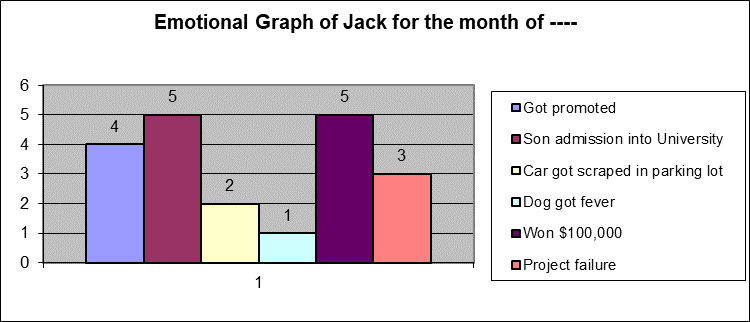
The EMOTION is from the HEART.
The emotions show power. It gives you a FEELING. The intensity of this FEELING gives you an idea of how far Jack is from the familiar feeling you have assigned as NOT GOOD NOT BAD or the Datum.
Whether the offset is GOOD and should evoke HAPPINESS” or BAD and should evoke SADNESS” is done by the MIND. There is an ongoing interplay between the HEART and the MIND. If we take the reason also into account, the above graph will look like this:
EMOTION MIND GRAPH
Unfortunately, the diagrams will not appear in the audio version.
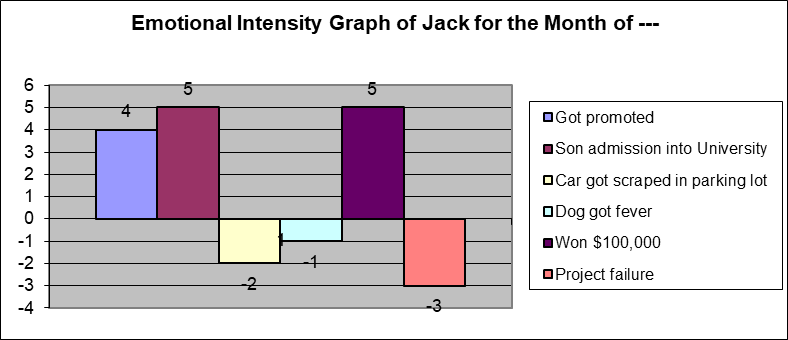
C. 5. Financial Difficulties
The numbers of marriages that are troubled because of financial difficulties are many. It is not only large because money is scarce, but also because of:
(a) Many people are discontented despite having enough, despite being well off, or even when they are rich.
(b) Many people do not know how to live within their means. Others want to have what ‘The Jones’ have. Little realize that before they can catch up with the Jones, the Jones have refinanced and acquired more and better things.
WHAT IS LISTED AS (a) IS NOT A REAL FINANCE PROBLEM; IT IS AN ATTITUDE PROBLEM.
THE MAIN REASON FOR (b) IS ALSO AN ATTITUDE PROBLEM,
But this problem tries to acquire at the risk of being a pawn to the financiers. So the problem is usually a mixture of:
(1) Not being able to handle money.
(2) And much more a question of prestige needs.
There are undoubtedly many practical cases, like sickness, retrenchment, business recessions, death of a breadwinner, war, etc. All these reasons need special directives because it has to deal with the cause and whatever measures are necessary to alleviate the problem. Each case is different and unique.
Finance problems are relatively easy for the couple to identify. There are many books written on this subject. Valuable tips and guidance are relatively easy to come by. In Chapter MONEY, I will try to bring a Biblical insight to this topic.
C. 6. SEXUAL PROBLEMS IN MARRIAGE
There are many books on this subject, but in keeping with the theme of this book, I will mention two issues which women most wished their husbands understood.
- The critical differences between Men and Women. Despite the efforts of radical feminists who vigorously (and foolishly assert) that the only distinction between the sexes are environmental and cultural. The truth is: Males and females differ bio-chemically, anatomically and emotionally. They are different in every cell of their body because men and women carry different chromosome patterns. There is considerable evidence to indicate that the Hypothalamic region, located just above the pituitary gland in the mid-brain, is “wired” uniquely for each of the sexes. Thus, the hypothalamus (known as the seat of the emotional interface between the “MIND” and the “HEART”. It provides women with a different psychological frame of reference than those men.
- Further, female sexual desires correlate with the menstrual calendar, whereas men are Acyclic. These and other features account for the undeniable fact that masculine and feminine expressions of sexuality are far from identical. Failure to understand this uniqueness can produce a continual source of marital frustration and guilt. Two more substantial differences in sexual appetite are worthy of note.
First, men are primarily excited by visual stimulation. They are turned on by feminine nudity or glimpses of semi-nudity. Women, by contrast, are much less visually oriented than men. Sure, they are interested in attractive masculine bodies, but their physiological mechanism of sex is not triggered typically by what they see; women are stimulated primarily by the sense of touch. Thus we encounter the first sense of disagreement in the bedroom: he wants her to appear unclothed in a lighted room, and she wants him to caress her in the dark. Second. (And more critical), men are not very discriminating regarding the person living within an exciting body. A man can walk down a street and get stimulated by a scantily clad female who shimmers past him, even though he knows nothing about her personality, values, or mental capabilities. Her body itself attracts him. Likewise, he can become almost as excited over an unknown nude model photograph as he can in a face-to-face encounter with someone he loves. The male focus and the sheer biological power of sexual desire are in an attractive female’s physical body. Hence, there is some validity when women complain that they have been seen as ‘Sex objects’ by men. These ‘seen as Sex objects’ by men explain why female prostitutes outnumber males by a wide margin and why few women try to rape men. It explains why a roomful of toothless old men can get a large charge from watching a strip-tease dancer ‘take it all off.’ It reflects that masculine self-esteem is more motivated by a desire to ‘conquer a woman’ than by becoming the object of her romantic love. These are not very attractive characteristics of male sexuality; nevertheless, professional literature has documented these traits. These factors stem from a fundamental difference in the sexual appetite of males and females.
Women are much more discriminating in their sexual interests. A photograph less commonly excites them; their desire usually focuses on an individual they admire and respect. A woman is stimulated by the romantic aura surrounding her man and his character and personality. She yields to the man who appeals to her emotionally and physically. Sex for men is more physical; Sex for women is a deeply emotional experience.
A problem in marriage can arise because the woman does not feel a certain closeness to her husband. For instance, a man comes home from work in an unpleasant mood, spends every minute working over his desk at home, goes through the meals in a preoccupied mind, watches the late news in silence and finally goes to bed without a word. The moment he sees his wife in a nightgown, it is enough to throw some switches, and his sexual desire is ON. The fact that he and his wife had no tender moment the entire evening does not inhibit his sexual desire significantly. But his wife is not so easily moved. She waited for him the whole day and when he came home he hardly even greeted her, she felt disappointed and rejected. His continual coolness and preoccupation put a padlock on her desires. Therefore, she may find it impossible to respond to him at night. To take the point a little further, in the absence of closeness, she feels like a prostitute. The inability to explain this frustration is, I believe, a continual source of agitation for women.
The Variability in Desire‚
Men and women also differ significantly in their manifestation of sexual desire. Researchers seem to indicate that the interest in pleasure and excitation at the time of orgasm in women and ejaculation in men is about the same for both sexes, although the pathways to that excitement take different routes. Most men can become excited more quickly than women. Men may reach the point of finality before the mate gets their mind off the evening meal or what the kids will be wearing tomorrow. A wise man recognizes this feminine inertia and brings his wife along at her own pace.
It is also apparent that men hunger for sexual release more consistently than women do. Many women are amazed at how regularly their husbands desire sexual intercourse. In this instance, there is a matter that husbands wish their wives to know about men. When the sexual response is blocked, males experience an accumulating physiological pressure, which demands release. The gland containing semen gradually fills; as it reaches this maximum level, hormonal influences sensitize the man to sexual stimuli. Whereas a particular woman would be of little interest to him when he is satisfied, he may be eroticized to be in her presence when he is in a state of deprivation. A wife may find comprehending this accumulated aspect of her husband’s sexual appetite demanding since her needs are typically less urgent and pressing. Thus, she should recognize that definite biochemical forces dictate his desire within his body. If she loves him, she will seek to satisfy these as meaningfully and regularly as possible.
On the question of variability in sexual appetite, men and women differ. The enormous differences between women range from Low – Inhibited Average Excited High. It requires much sensitivity to understand this and help them achieve a satisfying experience. Variability in sexual appetite is particularly unfamiliar terrain for men because men do not have such extensive diversity.
We must also be aware that a wife can often have difficulties in playing three unique roles expected of her. She is in a ‘Three Ring Circus’ all the time. She must be a wife, a mother and a mistress. A loving wife looking after the home and caring for the children is unlikely to feel like a seductive mistress who tempts her husband into the bedroom. Likewise, motherhood requirements are sometimes incompatible with the alternate roles of wife and mistress. Though these assignments seem contradictory, a woman has to often switch from one part to another at short notice. Her husband can help by getting her away from the wife and mother’s responsibilities when it is time for her to be his mistress.
Physical exhaustion plays a significant part in a woman’s ability (or inability) to respond sexually. A mother can quite easily have a 24-hour day when she has a small child (or children). When she finally falls into bed, sex can represent an obligation rather than a pleasure. It is the last item on the ‘to-do list’ for the day. Meaningful sexual relations utilize a significant quantity of body energy.
There is a strong connection between self-worth and the ability to respond to sexual stimuli. Any ridicule, even in fun, like the size of the wife’s breast or buttocks, will make her self-conscious and uncomfortable. Any disrespect he may reveal for her as a person is sure to crop up in their physical relationship.
The uninformed seem to suggest that sexual difficulties cause most marital problems. But the opposite is true, that marital problems cause most sexual issues. Women have greater constitutional vitality, perhaps because of the chromosome difference. Usually, she outlives men by three to six years. The sexes differ in their metabolism; women typically are lower than that of a man. They differ in the skeletal structure; a woman has a shorter head, broader face, chinless protruding, shorter legs and longer trunk. The first finger of a woman’s hand is usually longer than the third; the reverse is true with men. Boy’s teeth last longer than those of girls. A woman has a larger stomach, kidneys, liver, appendix, and smaller lungs.
Women have several significant areas lacking in men menstruation, pregnancy, and lactation. All these influence behaviour and feelings. She has more different hormones than a man does. The same gland behaves differently in the two sexes. A woman’s thyroid is larger and more active it enlarges during pregnancy and menstruation. It makes her more prone to goitre and provides resistance to cold. It is also associated with smooth skin, a relatively hairless body, and a thin layer of subcutaneous fat, essential to personal beauty. It also contributes to emotional instability she laughs and cries more easily. It also explains why girls giggle more easily. A woman’s blood contains more water. And 70 % fewer red cells. Since these supply oxygen to the body cells, she tires more quickly and is more prone to faint. Her constitutional viability is, therefore, strictly a long-range matter. When the working day in British factories, under wartime conditions, was increased from 10 to 12 hours, women’s accidents increased by 150%, while it was near 0% for men. In brute strength, men are 50 % above women. A woman’s heart beats more rapidly (80 vs 72 for men); blood pressure is 10 points lower than a man’s and varies from minute to minute, but she has much less tendency to have high blood pressure at least until after menopause. Her volume capacity for breathing power is lower in the ratio of 7:10.
She tolerates higher temperatures better than a man; her metabolism slows down less.
C. 7. Menstrual and Physiological Problems
Menstrual Problems bring physical and emotional deterioration in some women. A physical and emotional breakdown can come on suddenly until given proper treatment. The only advice is to see a doctor because the appropriate professional diagnosis treatment is the only resort. Frankly, it would be best to consult a doctor who is an expert on the subject because the regular run-of-the-mill tests reveal no disorder. And the general verdict is pronounced as, “You are OK” , “Put up your chin look on the brighter side of life and your marriage,” “Think of your beautiful children etc.” It is not just an outlook of life attitude. It is a real medical problem driving her (and her whole family) through hell.
Weight loss, trauma, paranoia, depression, despair, tranquillity, and opposite reactions are not just outlook problems. Besides expert medical knowledge, the Doctor must have an enormous understanding. The point is to find a good gynaecologist. Generally, hormone-induced stress is more challenging to identify. They also tend to change for reasons that are not environmental. One of the common human natures is to assign a reason for things. Especially for those factors which are not obvious. In this case, the outlook is to blame someone, something, or even oneself. The hormonal problem can fall into the category of undetected disorders. A word of extreme caution is a medicine that suits a specific person, may not work for another woman with apparently identical symptoms and may produce entirely different reactions.
There is a relationship between the estrogen level and the emotional stability of a woman. Therefore, it is surprising how uninformed many medical practitioners are, particularly those where work does not involve gynaecology.
Approximately twenty-two specific ailments can be triggered by estrogen deprivation, although few women experience them all.
Emotional Symptoms
1 Extreme depression, perhaps lasting for months without relief.
2 Extremely low self-esteem, bringing feelings of utter worthlessness and lack of interest in living.
3 There is an extremely low frustration tolerance, leading to an outburst of temper and emotional ventilation.
4 There are inappropriate emotional responses producing tears when things are not sad and depressing during relatively good times.
5 Low tolerance to noise. Even the sound of a radio or the usual responses of children can be highly irritating. Ringing in the ears is also common.
6 A greater need for proof of love is required. Suspicion of a rival is common.
7 Interferences with sleep patterns.
8 The inability to concentrate and difficulty in remembering.
Physical Symptoms
1 Gastrointestinal disorder, interfering with digestion and appetite.
2 The ‘Hot flushes’ burn in various body parts for a few seconds.
3 Vertigo (dizziness)
4 Constipation
5 Trembling
6 Hands and feet tingle and ‘go to sleep’.
7 The dryness of the skin in various places and loss of elasticity.
8 Dry mucous membranes, especially in the vagina, make intercourse painful or impossible.
9 Significantly reduced libido (sexual desire).
10 Pain in various body parts, shifting from place to place (neuralgia, myalgia, arthralgia.
11 Tachycardia is an accelerated or racing heartbeat leading to palpitation.
12 Headaches.
13 The dark, gloomy circles around the eyes are a symptom that doctors have found most helpful in preliminary diagnosis.
14 Loss of weight.
(The accuracy of these symptoms is verified in a recording produced for professionals by Ayerst Laboratories, featuring the voice of Dr Herbert Kupperman, Professor of Obstetrics and Gynecology, NY University).
The plight of the situation is that even though the husband and children (or even the extended family circle are sympathetic, they have no‚ ability to help through their kind efforts alone. Sympathy or kindness cannot rectify a hormone imbalance.
In C. 4. We came across some typical marriage syndromes. Now we will discuss a characteristic clinical syndrome.
“THE FALLING DOWN HANDS SYNDROME”
The patient tends to drop their hand or arms in a gesture to mean; I cannot go on anymore, If someone asks her where the problem is, she is likely to say, “Everywhere.” If a medical practitioner asks her about specific areas like, “Are your arms paining?” she will say, “Yes.” When asked if her stomach feels bloated, she will say, “Yes.” If asked if she has cramps in her feet, she will say, “Yes.” She gives you the impression that everything is out of order with her. Sort of, “You name it. I have it.” When dealing with one such patient, the nurse was so exasperated with all the “Yes” answers she was getting that she finally asked the patient, “Do your teeth itch?” To her shock, the patient replied, “Yes.” An answer like this is not stupidity. It is a syndrome.
Most of the points mentioned above relate more to women during menopause because of the change in estrogen levels. Let us now discuss the emotional problems common to younger women during the menstrual cycle.
First, I would like to stress a fact understood by very few women. Self-esteem is directly related to estrogen level; hence, it fluctuates predictably through the twenty-eight-day cycle.
Unfortunately, the diagrams will not appear in the audio version.
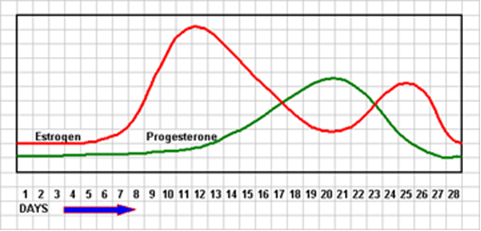
Normal Hormone levels and mood. The purpose of this graph is only to draw attention to the possibilities of using graphic illustration.
Observations:
- Moods change with the fluctuating hormone levels.
- Women feel the most self-esteem, minimal anxiety and hostility at mid-cycle.
- It is also the time of the highest emotional optimism and self-confidence.
Another hormone, progesterone, is produced during the second half of the cycle. Progesterone increases tension, anxiety and aggressiveness. Finally, the two-hormone decreases during the premenstrual period, reducing the mood to its lowest point. This low-mood level is accurate for neurotic, psychotic and normal women alike. The premenstrual phase is associated with feelings of helplessness, anxiety, hostility and yearning for love. At menstruation, this tension and irritability ease, but depression often accompanies the relief and lingers until the estrogen level increases.
On a typical graph like the one shown above, professionals can superimpose various other pieces of information, such as the ‘Mood Curve’. This way, it is possible to create a method to predict mood trends. Similarly, other estimations are possible by superimposing different curves, like a curve, to help those planning to have (or not to have) a child.
For those actively solving their problems, it would be advisable for them to make their observations and plot these values themselves. After all, the 28-day cycle can vary from woman to woman. Similarly, you can superimpose mood swings. After doing these charts for a few months, you may be able to predict the pattern yourself. If something is erratic, use the charts to explain yourself to a professional in a better way. It will also help the professional suggest a quicker and better method because of the data on hand.
The information provided above can be invaluable to a woman who wants to understand her body and its impact on her emotions. Most important, she should interpret her feelings. If she can remember that the despair and sense of worthlessness are hormonally induced and have nothing to do with reality, she can easily withstand the psychological nosedive. She should give herself a little pep talk like, Even though I feel inadequate and inferior, I refuse to believe it. My real problem is physical, not emotional, and it will improve! Women certainly wish their husbands understood these physiological factors that play a vital role in the female body. The problem is that culturally these things are never brought up in conversation with boys or men. Further, the riddles of the internal mechanism of woman are seldom, if ever, a matter of curiosity in a man So he is not prone to seek out knowledge of these subjects. On the other hand, the riddles of science, astronomy etc., may take him through the available lengths and breadths of the study material.
Never having had a period, it is difficult for him to comprehend the bloated, sluggish feeling which motivates his wife’s snappy remarks and irritability. Therefore, it would be beneficial if a husband would somehow learn about this subject and anticipate his wife’s menstrual period to recognize the emotional changes that will probably accompany it. Of particular importance will be a need for affection and tenderness during this period, even though she may be rather unlovable. Therefore, he should avoid discussing financial problems or other earth-shaking topics until the internal storm has passed. Then, a sympathetic and understanding husband can satisfy the yearning for love who cares and understands enough to support his wife during the periodic pressures days.
Technically speaking, many engineering products also have what is commonly known as Characteristic Curves. These curves are charted based on observation of the product. These charts help to determine the expected character behaviour of the product at various ranges of usage. Most common effects have a fixed or definite logic pattern. In the study of ‘Artificial Intelligence,’ the additional step beyond fixed logic is FUZZY LOGIC. Millions of dollars are put every year into the study of Fuzzy Logic, which deals with machine logic and controls. For example, FUZZY LOGIC helps in family washing machines because of the wide assortment of fabrics like cotton, wool, linen etc. A simple selector switch will do it if people are willing to wash their clothes in several batches. On the other hand, the company may want to market a superior model that could clean various fabrics using more advanced intelligence and take the guesswork out of the washing process. These decisions are similar to what the housewife would have made if she had to wash a mixed batch of clothes. Cooking a meal also involves a fair amount of Fuzzy Logic on the wife’s part when she knows who is coming for dinner. The same dish cooked for different guests may be different at other times. For example, fewer onions if the father-in-law is coming and more salt if her mother is coming; extra bland for the husband and more vinegar for the aunt. Etc. Some we cannot describe certain decisions; they are just done, sometimes this way and sometimes another way. Descriptions that cannot be exactly described are also a Fuzzy Logic type. So, men try to understand there could be Characteristic Curves and Fuzzy Logic even in marriage, wives and mood swings. After all, we did not entirely dream up our technical systems; they are derivatives of observing nature. Technically, there is a subject called BIONICS, whose main thrust is to study nature and translate the inferences to make technical products.
While we are on the subject, we sometimes hear whether there is comparable Male menopause.
‘Male menopause is a question with cultural overtones that clouded the truth. This question has been flag waved by the feminist movement, which fears that female menopause will become an excuse to withhold leadership positions from middle-aged women. Although with age, men experience a level of change which is not menopausal. It is very different in original impact from that experienced by women. The changes are not related to hormonal alterations but are more psychological for men. It is difficult for a man to face the fact that he will never reach the occupational goals he has set for himself. His youth is rapidly vanishing. He will soon be unattractive to the opposite sex and realizes he will not reach his early dreams of power and glory. Men who have achieved less than they hoped are devastated by the realization that life is slipping away. These realizations are primarily the anxieties that ignorant people try to explain as male menopause.
Some individuals respond to it by seeking an affair with a young girl to prove their continued virility; others work harder and longer to overcome the inevitable; others become alcoholics; others enter a dramatic period of depression.
But even when the emotional impact is extreme, it is usually motivated by the man’s evaluation of his outside world. These same influences agitate a woman, but she has an additional internal hormonal turmoil undermining her security. Other things being equal, the feminine change variety is more difficult to endure, particularly if it remains untreated.
Now and then, a question is about why some women make it through menopause without needing exogenous estrogen. Nobody knows for sure what estrogen does to the feminine neurological apparatus. Physicians today know too little about the brain’s chemistry and the substances necessary for its proper functioning. The only guide for treatment is the clinical signs and symptoms, which the physician observes. In answer to the question, it may be that the ovaries or the adrenal glands emit sufficient estrogen to satisfy the needs of less vulnerable individuals.
Incidentally, the human female is the only member of the animal kingdom who outlives her reproductive capacity. All other species die when their ability to bear young ones has ended. Therefore, the twenty or thirty additional years typically granted to a woman can be the most meaningful and fulfilling in life if her body is maintained and cultivates a proper attitude. The right attitude is not by the efforts of the mind alone. It involves the BODY, MIND, HEART and SOUL. That is why prayer is so important as exercise, mental stimulation and love. By mental stimulation, I do not mean the ‘Soap-Operas’ or prolonged hours in front of the TV. I suggest getting involved in the community, social activities, good books, good films, courses in exciting subjects, hobbies, enjoying the grandchildren and goal-oriented activities.
No matter how sympathetic and well-intentioned, most men are baffled by the following behaviour of their wives. Their wife is going through premenstrual tension and becomes irritable and short-tempered; they try to console them and tell them that everything will soon be all right and not as bad as it seems. Pacifying talk tends to make the wife even more furious and unbearable. The poor husband feels like an idiot for trying to be understanding and kind. The reason why this approach fails miserably is that her need during this phase is different. She is not looking for an explanation of what happens during a premenstrual phase. She had plenty of such stages before she got married. And who is he anyway to explain? How many periods has he had to talk? She is not looking for consolation either. She is looking for understanding and, in some cases, agreement. He has no clue what understanding is on this subject. How can he agree if he does not understand what is going on? The remedy, simple as it may seem, is to tell him that he needs a different approach. A different approach is what she cannot tell him. She may be competent in explaining advice to others, even advising another man. She may be skilful in counselling another man regarding that man’s wife’s behaviour.
But she cannot explain it to her husband.
It is something like giving a Sex Education class to children. If the course is for other children, the teaching may be awkward. If the teacher’s child is in the class, it is difficult for both the teacher and her child. This problem is even more so if the child happens to be her son.
In the case involving a teacher and her child in a sex education class, the problem is one of being uncomfortable and embarrassing for both the teacher and her child. As a result, the question-and-answer part of the lesson is even more challenging.
The undertone, however, is different. In the husband’s situation, she feels frustrated and irritated, “Do I have to tell him these things – I cannot explain these things to him”. She feels frustrated because she knows he does not know, and she cannot open up herself. Furthermore, she does not consider him stupid and cannot communicate this point to him despite it. So, the man keeps making his mistaken approach, and she gets frustrated with his hopeless inability to understand her point. This situation is much the same as we saw earlier, about the man having a frustrating time at work. He comes home from work, not wanting a question about his work day. In her concern, she asks him the same question, day after day. He will not tell her straight out, “Do not ask me that question again. It drives me back to my work spot”.
Furthermore, he knows her question is out of genuine concern, yet he cannot communicate the feeling to her despite this. He will be able to explain it to another colleague’s wife very effectively, but to his wife, his attitude is, “Do I have to explain why I am bothered by her question?” Frankly, he has just extricated himself from his work spot to have peace. Now she has put him right back there. So instead of explaining it, he snarls. It has nothing to do with his wife; His frustration or irritation is purely an outside matter.
Back to the woman’s reaction and the husband’s surprise:
FIRST of all, she does not realize that her despair is related to her hormonal calendar.
SECONDLY, attempts to console her only cause more frustration and make her try to prove how terrible things are in her life. So much so that she is almost insulted by the husband (or anyone else), emphasizing the positive. Her NEED is not that she is seeking ‘ANSWERS’; her need is ‘ASSURANCE’, that at least one human being on earth understands what she is going through. She wants her husband to comprehend how tough it is. Pacifying remarks undermine this need; they force her to prove that she is suffering worse than her husband thinks. In this situation, an ‘ACCEPTING ATMOSPHERE’ is more needed than an ‘EXPLANATION’. Help by giving her an atmosphere where she can vent her bottled-up frustrations.
C. 8. Problems with the children
Bringing up a child requires both masculine and feminine personalities. There is no question that both role models are necessary. While one role model helps the child develop, the other helps the child understand. Each gender contributes to developing their children’s little minds, and a mother knows she cannot effectively play both parts. There’s no doubt about it; raising children as a ’Single parent’, whether married or not, is the loneliest job. Yet it is surprising how often, in a conflict, one or the other parent selfishly claims custody of the children. These strains show up in the child in many ways, causing complications at different levels of childhood and later in adulthood. Good parenthood is exceptionally vital for children. Besides the effects of strained parental relationships, there are various socio-economic factors. For instance, many husbands have to work long hours, which robs them of mealtime togetherness, evenings, lack of weekends because of outstation trips, entertaining, community obligations etc. Fathers rarely get enough time, even under reasonable circumstances. Problems of this nature are becoming more widespread.
The nature of the problem may take various forms depending on the child’s age, the circumstances they live in, the locality, and the amount of pocket money they may have or not have.
Time invested with the children is precious for you and them. In our adult sense of values, we often try to make them excel in some activity. While this is good, the time to walk around and ‘kick stones’ with them is perhaps more helpful because that is when their creative questions and abilities have ‘time’ to emerge. They need that. It has a tremendous impact on the rest of their lives. These so-called ‘Waste of Time Moments’ are perhaps the wealthiest investment you can give them for life. Here is where creativity and originality develop. Children cannot hold interest in any activity for long, so frequent changes are necessary; otherwise, they will get bored and lose their appeal. Your children will be with you for a few brief years, and the obligations you now shoulder will be nothing more than swirling memories. So, enjoy every moment these days, even the difficult times, and enjoy your satisfaction of doing an essential job, right?
A divorce or separation is a terrible trauma for a child. They usually learn to cope with their situations in one way or another, but the emotional impact will never entirely disappear.
One day I happened to have a visitor at my office. He is a free-lance person who has made it his mission to help young people avoid smoking, alcohol and drugs. Among the many points we discussed, one area was related to the relationship between Parents and Children. He showed me a beautiful collection of 20 points. Parents do play the most vital role in the life of their children. I want to share these 20 points with you:
YOU AND YOUR CHILD
1 Do not say “No” without saying “Why” but‚ help him understand himself and build his self-esteem.
2 Do not force him to act obediently, but‚ motivate him by practising what you preach.
3 Do not over-discipline him and cramp his personality, but‚ give him the freedom to learn from his mistakes.
4 Do not be over-protective and shield him from others, but ‚ encourage him to fight his own battles.
5 Do not pamper him and make him weak-willed but‚ allow him to know his weaknesses and face disappointments.
6 Do not make him a puppet in your hands, but‚ let him learn to make decisions and handle responsibilities.
7 Do not try to live your own life through him but‚ respect his individuality.
8 Do not give him a guilt complex by blaming him always but‚ help him to understand his faults and guide him to overcome them.
9 Do not ridicule his shortcomings and make fun of him, but‚ teach him to respect himself so that he can respect others.
10 Do not instil fear in him and breed violence, but‚ show him how to love you and others by giving love.
11 Do not be suspicious of him and his motives, but‚ have faith in him so he can have confidence in you.
12 Do not behave like a dictator and rule him but‚ be a friend and encourage him to share his problems with you.
13 Do not put undue pressure to achieve brilliant results in studies, but‚ try to discover his intrinsic aptitude and encourage him to follow.
14 Do not allow him to become a bookworm, but‚ help him to develop healthy interests and hobbies.
15 Do not allow him to be lazy and idle away his time, but‚ help him use his energy meaningfully and become physically strong.
16 Do not enforce rigid, dogmatic rules and make him dogmatic. Instead, allow him to have a broad vision.
17 Do not be blind to his faults and weaknesses, but‚ be strict and correct his habits before they become bad ones.
18 Do not avoid exposing him to social problems but‚ discuss and make him aware of social evils and how to avoid them.
19 Do not indulge in family quarrels in his presence, but‚ give him the security of a happy and loving home.
20 Do not give him everything else but your ‘time’ but‚ let him know how much he means to you by spending time with him.
Remember, ONLY YOU can make your child a happy and complete person.
9. IN LAWS
To better understand the complexity of the in-law relationship problems, it would be better to read Chapter No. 16 on JEALOUSY. However, some explained terms directly affect this topic. Furthermore, some syndromes are described earlier, like the ME-MY Syndrome; these play a vital part in this topic.
For the even more serious reader, it is advisable to read Chapter 6, EXPLANATIONS, because terms like MIND and HEART have a direct and specific meanings. In our ordinary language, we tend to exchange meanings and functions of these two dimensions of a human being.
In-laws can be a significant area of the problem because of their close connection with the couple. Where closeness is, is also the chance of conflict. For instance, in marriage, the struggle is because of proximity. This conflict stems from familiarity. For example, we do not have a dispute with a person living in the Arctic, the Amazon Jungles, or even the other end of the town. Those people may have problems among themselves, but we have no problem with them simply because we have no close contact.
In-law problems originate and perpetuate in our EMOTIONS rather than the area of our INTELLECT. In other words, the HEART is more at work than the HEAD. Faulty Emotion management is why problems exist. Some of these problems in various chapters, like jealousy, possessiveness, ‘ME-MY syndrome’, ‘Love me love my dog syndrome,’ etc., are easy to show up here too. After all, any of these influences can affect us. The same struggles we have towards overcoming our flaws in our relationship with our spouse will show up here also. Mastery over self is not confined to overcoming weaknesses in a marital relationship but to an overall skill in all relationships, including in-laws, friends, neighbours, colleagues etc.
Let us try and understand some of the factors that make us susceptible.
The psychological baggage: Before the couple married and formed their own family, each was a part of another family. They had lifelong bindings to people like their parents, brothers, and sisters. Including other people associated with them. They also had associations and attachments with their home, hometown, and peer group. All these influences contributed to their emotional makeup. Schooling, work life, and clubs brought additional formative structures to their thinking process. All these factors come into the marriage. Often, marriage will happen with a partner who has not had identical exposure. The struggles show up as:
(a) Each partner wants the other partner to appreciate the value points. With the same feelings.
(b) Despite all the wishes and efforts of the spouse, the other partner may not feel these points are of value. They certainly do not assign the same intensity.
(c) Just like the couple has a certain amount of psychological baggage. The in-laws also have attachment bindings to one of the partners. Because of this, they may try to show or maintain expressions of love, concern, attachment, possessiveness etc. In effect, they are trying (or perhaps struggling to maintain closeness.)
(d) One of the partners may view the in-laws as an interference, threat, an infringement on one’s territory. The moment such feelings come, the defence mechanisms switch ON. So, the escalation turns out to be a circle with more effort and investment- more defence, frustration , conflict more resentment.
The most destructive of all IN-LAW-related problems is THE FORMATION OF TRIANGLES. Like many other triangular formations contribute to marital conflict. The triangle could be, Husband Wife In-laws, It could be, Husband Wife Children, Husband Wife Career etc. We should be cautious of these so-called triangular formations. Husband and wife should be ‘one’ to break the triangle. In the first line, our selfishness and egos give us a hard time.
In-law conflicts between people of the same age or state are usually a result of JEALOUSY of some kind or another.
In-law conflicts between people of different age groups or states in life are usually a result of POSSESSIVENESS. Vast age differences bring generation gap complications. Some of which are below.
Generation gap-induced differences play a part in amplifying the complications. Many in-laws, because of their age, become childish. Childishness shows up in their behaviour. To pound them with heavy reasoning and arguments would not have the same success as when they were younger or more able. If you feel this is a problem, be generous in your attitude be big-minded. Please give them a wide margin. Little, if any, good will come out to tell them that they are childish.
We should also remember that they were more capable, more efficient, and quicker-minded when they were young. The older in-laws were in a position to accomplish goals and achieve success. All their success happened while today’s grown-ups were babies. We should realize that they are declining on virtually every front – physically, mentally, emotionally, for most people, even financially. Sometimes younger people think that these older people have their houses paid up; their cars also paid up. Likewise, their children are grown up and are no longer responsible. So, their finances must be plentiful. However, the sad reality is that health problems are likely to set in for many. The cost of medicines, doctor’s visits, and even hospitalization can be prohibitive. They practically pay today’s top prices with their savings when their salaries were only a fraction of today’s salary rates. Their money does not have the same purchasing power while earning and saving it.
More of the tasks and chores they did themselves in their younger days may need the help of someone else, including trips to get the essentials. Under these circumstances, even the best parents strive towards possessiveness. Growing old is not easy, and they have to cope with it. AND WE WILL GROW OLD. So the safest and most honourable way is not to add to their strains but to help them. As the younger person, you are ascending while they are descending. So it is for the one who is climbing to be big-hearted. Show them love, respect, and admiration; spend some of your time; help them.
In the complex behavioural patterns of in-law relationships, the most universally baffling ones to understand are:
A) The mother-in-law and daughter-in-law problem. Both parties have enough instinctive dislike and disagreement, which is a strain, especially on the husband. He finds himself between two warring women, who are both his. He cannot understand why women’s various disagreements so quickly and frequently stir up. As a result, he usually suffers a lot under strain.
What Husbands find hard to understand is what switches the mother-in-law and daughter-in-law relationship. Initially, the mother-in-law-to-be and the daughter-in-law-to-be are the best of friends. Then, a wedding and a few hours later, they begin to show signs of rivalry. The poor husband is bewildered at what is suddenly going wrong. He also feels his happiness is rapidly turning into gloom and sadness. Slowly he sinks into a state of wondering whether there is a method to their madness. Before the marriage, the situation was as follows:
The boy’s mother is anxious to get her son married. This lady has seen and helped her son through the ‘Miles stones’ in life as a child and young man. Now the marriage milestone has to be set in place and hacked from her ‘TO DO LIST’. Armed with this sense of duty, she compares every prospective young lady with an imaginary yet exhaustive checklist. As his mother, she wants the best for her son. She is eager for her son to get his food as he likes. She tells the fiancée-to-be all she can about her son and is most keen to answer her questions.
On a more advanced plane, there is a feeling toward eternity. This feeling is in all people. Even though our life on earth is limited, we instinctively try to enable continuity through our children and grandchildren. The young lady is now that factor by which she will get grandchildren.
The young lady is equally anxious to know all about her husband-to-be. She wants to please him, make the best possible impression, and know the “Whole Story” about his being. The best resource person is his mother. (In similar ways are his sisters, sisters-in-law, cousins, and friends).
There is nothing wrong with this. It is only fair that the young lady wants to know about her future husband from the best possible source. Furthermore, it is reasonable that the mother seeks to equip the future daughter-in-law with all the tips needed to be a good wife to her son.
So, both go on as great friends. The mother enjoys talking about her son in detail, and the young lady enjoys listening and daydreaming simultaneously.
After many stories with heart-to-heart talks and cooking recipes later, the young lady gets married.
Passing information on and receiving data is when both women reach an ‘Emotional Super High’. Eventually, the super high has to fall. It is a question of where the outcome of the emotion is allowed. It can fall into ‘understanding’, or it can fall into ‘POSSESSIVENESS’. If the sentiment falls into possessiveness, the MY Syndrome will result.
When a boy marries, three major psychological upheavals result.
1) In the mother’s HEART, she FEELS a long and cherished binding is breaking. She feels forced to relinquish her hold on her dear son. Still worse, she feels she has to sidestep to make way for another woman. The hardship is not her REASONING; the struggle is with her FEELING and INSTINCT.
2) In the daughter-in-law’s HEART, she FEELS she has to establish a binding. She feels she has to assert her right of claim. Still worse, she feels she has to get rid of the other woman in her husband’s life. It is MY husband. As in the case of the Mother-in-law, the Daughter in law also faces a similar scuffle. The hardship is not her REASONING; the struggle is with her FEELING and INSTINCT.
3) In the MIND of the husband/son. He knows his relationship with his mother is different and unique from that of his wife. However, there is no question that either of these two women can switch places with each other.
The thought-provoking part is that when it concerns another person’s son/husband, both women will agree that the mother’s role differs from the wife’s, even relating to each position in the man’s heart. And yet when it comes to their own son/husband, they act differently. So here again, we see that it is not a question of the intellect but raw feelings.
The reason is quite simple when they look at other people , they “think” with their HEAD. When they look at themselves, they “think” with their HEART. In other words, when it comes to their own son/husband, EMOTIONS override brains. In simple terms, they are ready to fight. Each woman wants to remove the other’s MY BLANKET and have only her blanket firmly and securely spread over her possession – the man.
Because of their emotional possessiveness and willingness to fight, they inherently have reflexive action to this trait. That is: Women instinctively wish someone would fight over them. This spontaneous action does not come about because of marriage. – The instinct was always there.
For example, two boys may be ready to come to blows at a dance because of a girl. This catastrophe sends the girl into an EMOTIONAL SUPER-HIGH. She will remember it for years to come. She may protest the fighting, but she will still cherish remembering that some man fought over her. – Her emotional self-worth has jumped up many points. First, she is elated, “I was fought over !!!”. Then, she will brag, “ Men fought over me.” And other girls will say “Wow” on the outside and feel jealous on the inside.
For example, one girl casually bragged to her other girls, “Men fought over me at last night’s dance”. The others left whatever they were doing because this claim was monumental. The other girl’s conversation went as follows: “Men fought over YOU??? !!!”; “Listen up, girls, men fought over HER!!!” “Now, listen here, we do not even have a man to fight WITH !!! and you had men fighting over YOU.”
She is willing to get pugnacious if her “MY” is put down in any way. Her MY can be, for example, someone talking bad about her husband, her children, her family, her husband’s family, her school, even though she is no longer a student, her country, or whatever.
REASONING.
If women were willing to understand this explanation, it would make things much easier for themselves, their husbands and family.
For those lucky ones who can go for a HONEYMOON, this is one of the best things that can happen because:
(1) It is a romantic time like a holiday. It gives the newly Wed couple time to feel good. Sooner or later, the honeymoon will end, and regular life will begin. There will be lots of ups and downs in everyday day-to-day living. But, at least in their memory, they can re-live this enchanting experience of being newlywed.
(2) It is a time when the young lady has the chance to spread her “MY” claim over her husband. Being away from the in-laws and on holiday, she can relish the feeling of “He is Mine.” “He is Only Mine.” The Honeymoon was a definite break away from his family, even if only for a few days. The honeymoon break gives a definition that now she has him. When they return, she feels ‘He is mine’, and I am willing to share him with you.
(3) It is also supposed to be when the mother-in-law can come to terms with this new development in her son’s life. She needs this time to walk down memory lane to remember her tiny baby, her small boy, her big scout, her graduate when he came home and placed his whole first pay in her hands. A mother’s heart has many things she will pick up and re-look at down memory lane. Tears will certainly roll down her cheeks, and she needs time and stillness to do this. Then, if she gets a chance to make this emotional adjustment well, she will be able to greet her daughter-in-law as they return from their honeymoon with genuine warmth in her heart.
Some women can survive these heart-shaking emotions well. Most, however, will have difficulties. The primary deficiency is the lack of training to be willing to let go. People have no training to place their focus on God. This focus is done with the HEART, not by the intellect. Especially since both women find it tricky, they need to surrender their feelings to GOD. And ask God to come into their heart. They need conscientious training to place each negative emotion of Anger, Jealousy, Possessiveness, Bitterness, Resentment, etc., to GOD. They have to say, for example,
- “Dear God, I am feeling resentful. Please take this feeling.”
After some time, this spiritual reflex of surrender will become second nature.
The stage beyond this would be to wish the other person well, for example:
- “Dear God, I feel bitterness. Please take this feeling. Bless . . . . . . . . . and bless me also.”
a) Initially, it will be challenging, but God’s grace will gradually help you overcome our fallen nature’s defects.
b) The mother-in-law and son-in-law relationship are, by and large, better. But there is more than enough evidence to show that the mother-in-law tries to be good to their son-in-law (and they are good to their sons-in-law). Yet, the son-in-law responds with distance, aloofness, dislike, and coolness for some inexplicable reason. The wife cannot understand the reason. She often wonders, “My mother is so good to him, and he does not show a liking for her.” She also wonders how other male friends of similar age or background as her husband have no difficulty liking her mother.
c) What wives and mothers sometimes wonder how fathers get along much better with their sons-in-law and daughters-in-law. But, of course, the father-in-law may get on very well, even though they have such a hard time having a harmonious relationship with their wife.
Men are generally not ’MY’ oriented in these Matters (see “ME-MY Syndrome” Also see Chapter on Jealousy). Hence they are less possessive. Both the Son-in-law and the Daughter-in-law somehow perceive this more by instinct than reason. So consequently, there are no feelings of FEAR or THREAT to any people concerned. Chapter 23 is devoted to FEAR-THREAT Situation.
People have been trying to understand and explain these baffling behaviours for ages. There are many theories and explanations. If this is a problem, it will certainly help to read more about this particular area. As a word of caution, one must not assume that the understanding will be easy. The best way to handle the issue is to:
(a) Try and understand as much as you can.
(b) Accept that there are areas that are difficult to understand.
(c) Try to improve oneself by being better in-laws to the rest of the family.
C. 10. AGEING
One of the causes of depression is associated with age. So the primary orientation of this book is tuned towards young marriage and what we may term as the ‘first half time’ of marriage. Initially, spending word on this topic may seem superfluous, but let us re-look at what we have been reading. The tone of this book has been:
(a) To understand what happens in a marital relationship.
(b) To bring our attitude towards achieving marital harmony.
We have tried to understand our position in a marriage relationship with these two aspirations in mind. On one side, we know what happened because past experiences are etched in our memory. The present is with us right now. But we do not know the eventualities of the future. We can only rely on our observance of what happens to older people and at least know some of the probabilities that age brings. Because of observing people more senior than us, we have some idea of age-related problems. We must also realize that we are heading towards ageing with each passing year. So I feel the words spent on this topic will contribute to our understanding and attitude development. Eventually, we look at the broader context we may be in beyond the young marriage situation.
For one thing, Retirement is a total lifestyle change. One soundest advice is to get hold of a book at least five years before retirement, and both partners bring themselves into the correct frame of mind. People who do not pre-inform themselves of Retirement encounter a rude and rough shock. It is also complicated because, at that age, the ability to accept changes is demanding. Other attitudes, and the strength, to execute these changes have become more inflexible. Changes bring problems of coping both for themselves as well as for others.
Let us try to appraise some of the problems associated with age. Some of these points have and will appear again in different sections of this book.
The thrust mentioned here is:
A) To understand the source of depression likely to crop up in our life.
B) Understand the probable reasons for our problematic and frustrating experiences with others.
With age, we tend to listen to things our mind says. Something that we did not care about when we were younger. Some are ‘Questions’, others are ’Statements’. These ‘Statements’ or ‘Questions’ hit some people with an impact, but it grows gradually in others. Some of these questions and statements could sound like this:
Suddenly I am not young anymore!
I have not achieved enough!
There is no time to catch up with all my expectations!
I have not provided adequately for my/our old age what shall we do?
I cannot do the things I did before.
I am not profitable.
My health is not the same anymore.
I am just deteriorating.
Am I still good-looking?
Do they still like to be seen with me?
Things that never bothered me before are now assuming frightening importance.
I am just not used to doing nothing.
I am just not used to having him at home during the day.
I thought this would be a time of rest and freedom from the tensions of life. But now I find my mind keeps me away from rest. And the strains are only different.
There is a lack or less financial income.
Hormonal changes.
Lack of stamina, especially when the grandchildren are around. Running around children creates fatigue, irritation, anger and, subsequently, a bad feeling of guilt.
This list can go on and on. Keep in mind that these feelings are real. The effects are bound to show up in our relationship. As age goes on further, people tend to get childish; this brings reactions, often hurting them.
Earlier, we had listed ten factors causing female depression and asked to rank them in order of importance. If you did this ranking as a young person, ’Age’ would have been right at the end of your priority list, but if you are older, the circumstances are different, and it occupies a higher ranking. When seen through the eyes of younger people, these problems are of no significance, so they could adopt a wrong attitude toward older people, who are a part of their lives. We struggle to put all our attitudes into a correct perspective. Putting our attitudes into the proper mindset is a lifelong task and a race we run. As St. Paul puts it:
2 TIMOTHY 4:7
“I HAVE FOUGHT THE GOOD FIGHT, I HAVE FINISHED THE RACE, I HAVE KEPT THE FAITH.”
The race that we run is not against age, but it is about doing a lot of good things, including shaping a good attitude so that when age has brought us up to the point when we can look back, we also can look back and say the exact words as St. Paul in 2 TIM 4:7.
LET US NOW EXAMINE WHAT THE BIBLE HAS TO SAY
Now let us turn back to the Bible.
1 PETER.3: 7
7 “LIKEWISE YOU HUSBANDS, DWELL WITH THEM WITH UNDERSTANDING. . ”
The words WITH UNDERSTANDING also imply ‘KNOWLEDGE’ if you do not know, how can you effectively understand? But this is a remarkable paradox. God says a husband should live with his wife with understanding (and knowledge of her fundamental nature and needs). But as we mentioned, most men know very little about the female race’s emotional mechanics and make-up. Is that the reason why so many marriages break up?
When God says husbands live with understanding towards their wives, it must be possible that husbands can have some idea about wives even though this statement seems to run contra to popular opinion.
The second half of this verse of 1 PETER 3:7 reads,
7 “. . . GIVING HONOR TO THE WIFE, AS TO THE WEAKER VESSEL, AND AS BEING HEIRS TOGETHER OF THE GRACE OF LIFE, THAT YOUR PRAYERS MAY NOT BE HINDERED.”
Give honour to the wife as to the weaker vessel. Women are the weaker vessel. It does not mean they are mentally, morally or spiritually inferior, only physically. Even though they are less prone to sickness and have a longer life span, they are generally weaker and smaller. God made them so that the more fragile will depend on the stronger. Because the wife is of weaker stature, she relies on her husband to provide for and protect her. His task is to provide food, clothing, shelter and protection.
On the other hand, she can bear children and provide them warmth and love. This care and warmth are something children, especially babies, need. However, this faculty, which God provided her with to perform this task effectively, is the second area of her weakness That is Her Emotions. A woman must often struggle with sudden and unexpected mood swings. These result from the chemical actions the hormones produce in her reproductive system. Earlier in this chapter, we touched on this point with some explanations.
These emotional vulnerabilities make her feel the need to depend highly on the man God gave her as her husband. It seems to be the underlining idea that God gave to Eve,
GENESIS 3:16
16 “TO THE WOMAN HE SAID: I WILL GREATLY MULTIPLY YOUR SORROW AND YOUR CONCEPTION. IN PAIN YOU SHALL BRING FORTH CHILDREN; YOUR DESIRE SHALL BE FOR YOUR HUSBAND; AND HE SHALL RULE OVER YOU.”
She looks to him with an inner longing to meet these basic needs for her.
The question is, how can a man do this? It is not a simple question for a husband; it is profound. It is deep because the husband is trying to say, “This woman hurts me every time, even when I am trying and willing to help her. She hurts my children’s feelings; they are innocent. What have they done? She is so stupid that she does not even realize how intensely she is hurting the people who love her and are willing to help her. How can you ever help such a person?”
Maybe most wives do not drive their husbands to such extreme thinking to make them feel that they must put up with a ‘stupid’, ‘A hurt producer’ or an ‘idiot’. But to varying degrees, there is an underlining feeling that this is plausible.
This kind of thinking sounds unfair in the eyes of the wife. Yet it sounds absolutely ‘Spot-On’ to their feelings for the man. The opposite thought is a case where it is FEELINGS Vs. FEELINGS both have reasons to feel correct because they think that way.
Let us see what the Bible says:
EPHESIANS 5:25
25 ”HUSBANDS, LOVE YOUR WIVES, JUST AS CHRIST ALSO LOVED THE CHURCH AND GAVE HIMSELF FOR IT.”
Christ did not look at us and say, “If they love me and appreciate me, I will be prepared to die for them and buy them redemption.” If Jesus had put that condition on sinful humanity, he would have no reason to die for us. So instead, he died for us regardless of our love or appreciation. A loving act like this is why we say God’s love is UNCONDITIONAL. GOD loves us with an AGAPE Love.
EPHESIANS 5:28
28 “SO HUSBANDS OUGHT TO LOVE THEIR WIVES AS THEIR OWN BODIES; HE WHO LOVES HIS WIFE LOVES HIMSELF.”
EPHESIANS 5:33
33 “NEVERTHELESS LET EACH ONE OF YOU IN PARTICULAR SO LOVE HIS OWN WIFE AS HIMSELF, AND LET THE WIFE SEE THAT SHE RESPECTS HER HUSBAND.”
COLOSSIANS. 3:19
19 “HUSBANDS, LOVE YOUR WIVES AND DO NOT BE BITTER TOWARDS THEM.”
We must realize that the Bible would not convey so many messages on marriage if God were unaware that we would struggle with complex tasks. All these tasks are there because God wanted us to learn the difficult lessons towards AGAPE love.
The husband’s headship is heavy duty to create an atmosphere that satisfies the basic needs of his wife in an atmosphere where she is free to grow and develop in everything that God wants her to be. Her submission will then be a voluntary response to his loving headship. The wife is the responder, and the keyword is ‘Response’. If she only gets criticism, disapproval, unfriendliness, indifference, un-appreciation, and no affection, she will react with her defence mechanisms like bitterness, coolness, defiance or nagging. Some wives turn to drinking; others immerse themselves in social activities. IF SHE GETS LOVE, SHE WILL REACT WITH LOVE AND DEVELOP INTO ONE OF THE LOVELIEST PEOPLE ON EARTH; THIS IS WHAT GOD WANTED HER TO BECOME. A happy marriage and home depend primarily on a wife, but a successful marriage depends on the husband. Therefore, the husband should love her unselfishly, even if it seems only for God’s sake.
She needs acts of love because she depends on assurance. Her nature is such that she also needs reassurance. And she may need this repeatedly for the simple reason that her psychological mechanism works that way. Men are different. They require far less assurance, so they are inclined to be less attentive to this need.
She needs a ‘helping hand’ because it conveys ‘I love you.’ Sometimes this ‘I love you’ is required to be demonstrated flowers, a bottle of perfume, even giving up a hobby sometimes.
She needs an enormous amount of encouragement. This point becomes more critical when the partners come from different regions or communities. In some areas, countries, or communities, paying compliments is expected and the right thing to do, whereas compliments are rare in other areas, neighbourhoods, or nations; they are less or may not be acceptable. In addition, some countries regard compliments as flattery. Just as complementing may be generous or thrifty depending on people from a particular background, the same sense applies to words of endearment or showing affection. Compliments are a kind of encouragement. The couple should be aware of each other’s upbringing influences because these differences can be very contrasting if they are not understood. Especially if the man comes from a compliment-thrifty region and she comes from an area of lavish compliments. Besides treating this behaviour as a lack of affection from her husband, she may feel the same about her in-laws, neighbours and other people. Because of a lack of understanding, she may feel she is not wanted , and coping with that is hard.
This need for encouragement from a wife can be so persistent that the husband may mistake it for grumbling. But, like one man once complained, “The way I know my wife, she would even find something to grumble about in heaven.”
At a counselling session, the conversation went like this:
Wife: “He does not compliment me. He does not give me any sign of his love for me.”
Husband: “What should I do? Should I genuflect every time I come home or sing ‘O-Solo-Mio’ under the balcony?”
Wife: “I do not mean that, but at least some sign, at a regular interval, so that I feel that you love me.”
Husband: “Every day, I come here home directly from work. Is that not a sign that I love you? And is every day not regular enough?”
From this conversation, it is clear that she is honestly asking to fulfil a need in her. She is on the wavelength of her feelings. On the other hand, the husband is exasperated because all his real homecoming does not seem to convey his love, which he assumes is a good and adequate sign of his affection. He is on the wavelength of Logic. Men generally think logically and are more stable in their thoughts, so they tend to be less demonstrative. He does not even consider demonstration necessary most of the time. Let us face the truth; wives need more demonstrative displays of love. Multi-million-dollar industries have recognized this need, and they make big money. Where would a saying like “Say it with flowers” come from if there were no need? And who does the gift and florist industry cater to Women to Men? Or: Men to Women? If the industry can recognize this need and profit from it, it is high time husbands also recognize this need in their wives.
Often wives complain that husbands take them for granted as maids around the house. They need appreciation, approval, attention, recognition and understanding. This lack of concern is that men have a kind of a tendency not to worry about things that work well. In the working world, this ability is of tremendous help. For example, suppose a man was in charge of a large factory or plant and worried about every person in his mission and every piece of equipment and machinery; he would have his brain cluttered up. He would be befuddled all the time.
Sometimes men say, “I would die for my wife!” But that is not what she would want; she wants “He lives for her.” But, most often, the man does not think of it this way.
She looks and longs for a demonstration of the ‘I LOVE YOU’. And here is the difficulty. And this is even more difficult when she is irrational and unreasonable.
This loving understanding costs a lot; in fact, it costs everything. It often means self-sacrifice. Self-sacrifice is what it cost Jesus when he died on the Cross. Go ahead, ask yourself why did Jesus die on the cross? The answer is love! For His Church! If you do not want to pay this price, you made a big mistake on the altar when you made your vows.
EPHESIANS 5:31
31 “FOR THIS REASON A MAN SHALL LEAVE HIS FATHER AND MOTHER AND BE JOINED TO HIS WIFE, AND THE TWO SHALL BECOME ONE FLESH.”
Some wives, in their selfishness, hold this saying high like a trump card and place strong references to the word ‘LEAVE’. But this word ‘LEAVE’ means that from now on, he shall start life with his wife and establish his family and become one entity “And they shall become one flesh”, But nowhere does the Bible mention that he should stop loving his parents or give them no respect. It does not command him to be aloof, cold or withdraw his affection. This saying does not push the fourth Commandment aside, which says,
“HONOR THY FATHER AND THY MOTHER.”
And it is not that the New Testament teaching displaces the Old Testament. Jesus addressed this question in the following:
MATTHEW 5:17
17 “DO NOT THINK THAT I CAME TO DESTROY THE LAW OR THE PROPHETS. I DID NOT COME TO DESTROY BUT TO FULFILL IT.”
When a man takes a woman to be his wife, he makes her a part of himself; that is why he cannot shut her out of his life. If he refuses God’s Commandment in this area, BITTERNESS AND RESENTMENT WILL CREEP INTO THE MARRIAGE. SPIRITUAL POWER WILL DISAPPEAR, AND PRAYERS WILL BECOME LESS EFFECTIVE. Many spiritual weak spots are a result of this. Therefore, it would be high time we followed God’s Commandments.
It is difficult for a husband to include a wife under the best circumstances. This difficulty multiplies many more times if his wife hurts his feelings. A man stands in a dilemma to accept or not to accept this commandment. The tests are apparent because he would have included her if there were no problems. Instead, he is shutting her out of some areas of his life because he has difficulties.
There are thinking difficulties; let me mention only three points:
- Men think differently. So subconsciously detects his wife has different thinking if the wife answers anything other than, “YES, DEAR”. So consequently, he relegates any thoughts from her as ‘opposing thoughts’ or contradictions.
- In his working world, he faces ‘opposing thoughts’ or contradictions as everyday occurrences and is specialized in his thought defences to survive.
- Under the situation of him PERCEIVING ‘Opposing Thoughts’ and Contradictions, if he also hears DEMANDS and IRRITATION and INSISTANCE, his defence mechanism tells him,” YOU ARE UNDER ATTACK” – – – “ACT.”
The only way to get out of the dilemma is to trust God entirely and shift your perspective from this world’s things to those that are God-centered and eternal.
A word to the wives: Let the indwelling of the Holy Spirit motivate your husband. Do not try to do God’s work for Him; God is quite capable of doing His work and doing it exceedingly well. If you try to restructure your husband, the results will fall short of your expectations. You may even make a mess of things. It is also not your duty to remind him of his duties. Instead, you should leave him in the hands of the Lord. Pray for him and be the person God expects him to be.
God Bless You.